
I am not sure how I feel about my trip to Antarctica as I sit in Punta Arenas, Chile awaiting my flight home. When I sign-up for a big adventure I usually hope for three main things: to suffer; to learn something about myself (usually the byproduct of suffering); and to develop new skills. I was certainly tested, but not in the way that I expected.
Cardiologists Friedman and Rosenman developed the Type A and Type B personality hypothesis in 1987. Type A personalities are typically characterised by a collection of the following attributes: ambitious, chronically competitive, results orientated, self-controlled, proactive, rigidly organised, status conscious, impatient and obsessed with time management, aggressive, quick to anger and potentially hostile. Type B personalities, in contrast, do not exhibit the same characteristics. According to the theory, we all lie somewhere on the continuum between extreme Type A and B personalities. Its probably fair to say that its easier to get along with a Type B personality than it is a Type A but both types have important roles to play in any social grouping.
I suspect that a psychologist would probably place me closer to the Type A personality type than that of a Type B. I like to think that I am sufficiently self-aware these days to recognise that some of my traits do not make me the easiest person to spend time with and I have worked very hard to conceal and manage the less attractive aspects of my personality, although sometimes I fail spectacularly.
I mention this because I have a theory, born from personal and second-hand experience, that the people who sign up to climb Everest, complete the Seven Summits, ski to the South Pole and so on are more likely to be Type A personalities. This is because, first, these trips are not cheap and there is some correlation between certain aspects of the Type A personality and wealth and so people leaning towards Type A are more likely to be able to afford to participate. Secondly, competitive, results orientated people often like such challenges. This suggests that in base camp you are going to see a higher concentration of Type A personalities than normal. This does not necessarily bode well for harmonious relationships in base camp!
I first met my group of fellow adventurers over dinner in Punta Arenas before our flight to the continent. It was an eclectic mix. Mark was a young (by which I now mean less than 40), Canadian former professional poker player and “crypto bro” now living as a tax exile in Malta. Song was an unassuming young man from China who, contrary to appearances, has completed nearly all the major ultra-endurance running events on the planet. Song decided not to ware sunscreen as he believes his body will adapt to the environment – needless to say his face looked like a pizza after the first day. Song was also planning to run the Antarctica Marathon and felt he needed to lose weight and so decided to leave all his food behind prior to starting the Vinson climb! Laura was a young Goldman Sachs banker who exhibited many of the characteristics you would expect from someone with such a CV and who was on the final stage of a year-long adventure sabbatical. Laura was accompanied by David, a Swiss mountain guide, who was there at the insistence of Laura’s family to ensure she came home in one piece. Muhammad was a fiery Moroccan financier with publications on erotic derivatives and self-help to his name who arrived with none of the equipment on the extensive kit list issued prior to the trip. The group was completed by Jose, a warm, calm, tall and handsome Spaniard who looked like he should be a model in an expensive knitwear advertisement. Of the seven of us, Mark, Laura, Mohammad, myself and to some extent David, leant heavily towards Type A personalities with Jose and Song leaning more in the opposite direction.
I cannot remember who once warned me that, if you cannot spot the ‘arsehole’ in the group, then it’s probably you. In groups consisting of a large number of Type A personalities there is often considerable competition for the role of ‘arsehole’ and so I usually feel quite safe that it’s not me. Unfortunately, I could not immediately spot any arseholes and so made a mental note to try and not be too much of an arse myself! Fortunately, as the trip developed there were some minor clashes between some other members of the party which hopefully means I was not the number one arse.
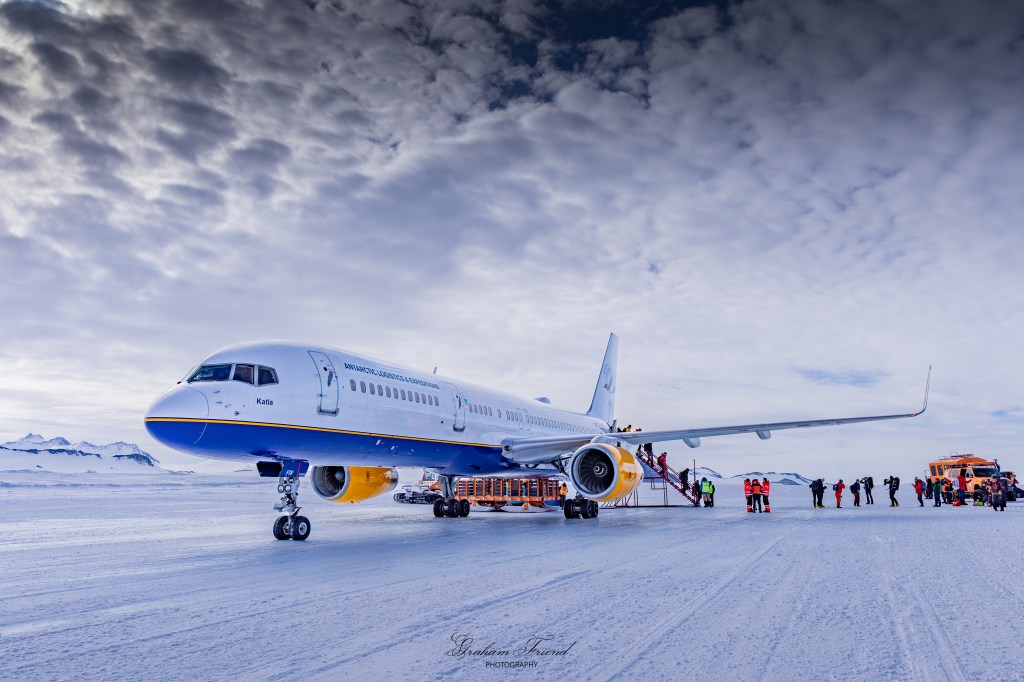
The flight from Punta Arenas, Chile to the blue ice runway on Union Glacier, Antarctica, takes four hours. The view from the window evolved from the ocean to sea ice, to snow with the occasional mountain rising up from the ice in the same way the peaks of the Alps sometimes rise from a sea of cloud. The length of the journey provided an initial insight into the vastness of the Antarctic continent.
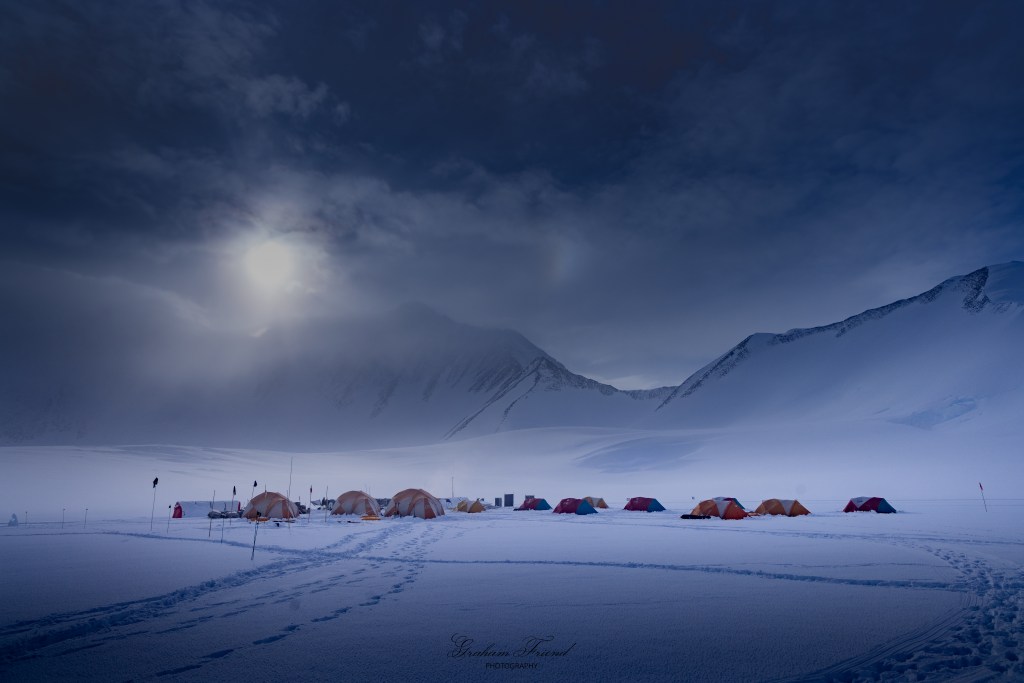
We arrived at the vast Union Glacier camp with its large and comfortable “clam” tents containing reasonably comfortable beds, a mess tent where first class, three course meals were served three times a day with cookies, cakes and snacks available 24 hours a day and a lecture theatre where speakers gave talks on a range of polar topics (always interesting). In addition, there were loo and shower facilities although the limited water resources meant showering only every 3 to 4 days whilst in camp. There was bright sunlight 24 hours a day – sleep was a rarity for me.
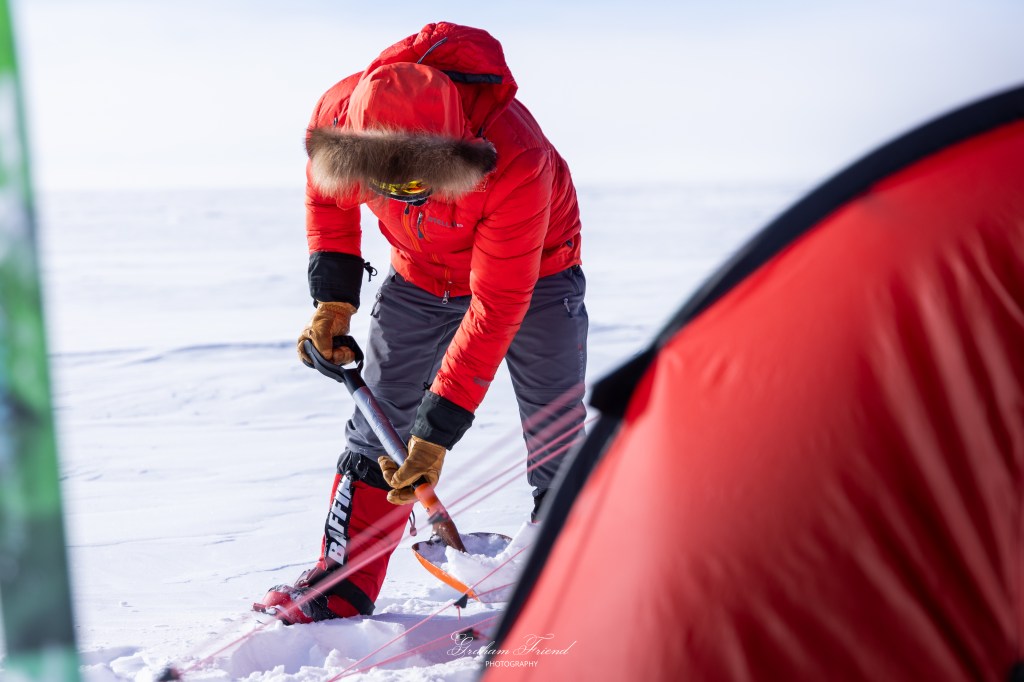
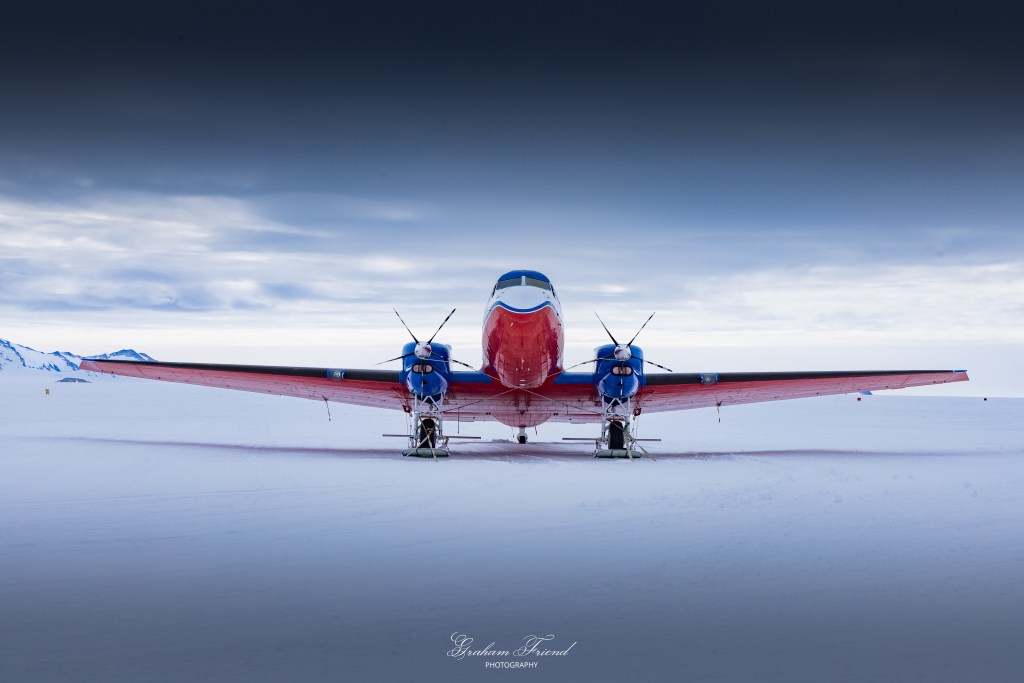
We sat around for a few days waiting for the weather and then finally flew in a Twin Otter plane to Vinson Base Camp (45 minutes). We were then able to move fairly quickly to low camp which involved pulling a pulk and carrying a rucksack with our gear over a period of 5 to 6 hours. It was an easy exercise for me – no suffering.
There were a number of teams in Low Camp in addition to ours and we were all waiting for a weather window to move to High Camp. The weather is very unpredictable in Antarctica and we waited, waited and then waited some more. There was a small opening in the weather and all the other teams decided to pack-up and move to High Camp despite the anticipated challenging conditions higher up the hill. Our guide decided we should wait some more.
Our guide was an interesting, intelligent character. A British former soldier called Stuart and I am still not sure if he was in the special forces even though he told me he was not. Stuart was exceptionally knowledgeable and I had a lot of respect for his expertise and experience. Unfortunately for the Type A personalities in the group, Stuart had a habit of giving vague and off-hand answers to any question relating to the timings for the next stages of the project. I am pretty certain that this was a deliberate ploy to annoy the Type As, possibly arising from his clear anti-authority nature (based on a series of amusing anecdotes he told us) and a possible association in his mind between Type A personalities and authority. Needless to say, this created a great deal of emotion and stress for a significant number of the group including myself at times. I do not doubt for one minute that his decision to delay our departure was the right one but the manner in which his thinking was communicated was not ideal. I was frustrated but no where near as frustrated as some of the others.
Eventually we set off for High Camp. The climb was easy for me although the last 10 minutes were tougher due to a combination of limited food and altitude. Other members of the group found the climb very challenging despite the perfect conditions and confirmed that Stuart had made the right decision to delay.
Reaching High Camp was a turning point for the Type As. We recognised Stuart’s sagacity and were beginning to accept that we had little control over the timing for the climb. This was particularly significant for Laura and me as we were both scheduled to complete the “last degree” ski to the South Pole after Vinson and so the timings mattered.
Again, we waited and waited and then waited some more at High Camp before eventually waking to a perfect summit day weather window. The climb was very easy and the only moment of interest was when I needed to swap from gloves to mittens and I became a little flustered. The temperature was -40 degrees and with winds of 5 to 10 km/hr the combined effect was a temperature of around -50 which meant that skin cannot be exposed for anything more than the briefest of moments.
The guide time for round-trip climb is 9 to 12 hours. I was with Stuart and Mark and we completed it in just under 8 hours. The pace was dramatically slower than the speed at which I normally move on mountains (Swiss guides are always so fast) and whilst a little frustrating, it did mean that this was a very enjoyable stroll. I was not challenged by Vinson other than dealing with the uncertainty and frustration – my kit ensured the cold was generally not a bother.
After returning to High Camp, we were able to swiftly descend to Vinson Base Camp in great weather and in an ideal world, a plane would have whisked us straight back to Union Glacier. If there had been a plane we would still have been on schedule for the Last Degree. Unfortunately, there was no plane waiting (other operational priorities the reason apparently) and then the weather closed in and we were stuck in Vinson Base Camp for a further few days which was eating into our Last Degree.
Finally, the cloud lifted and we were able to fly back to Union Glacier.
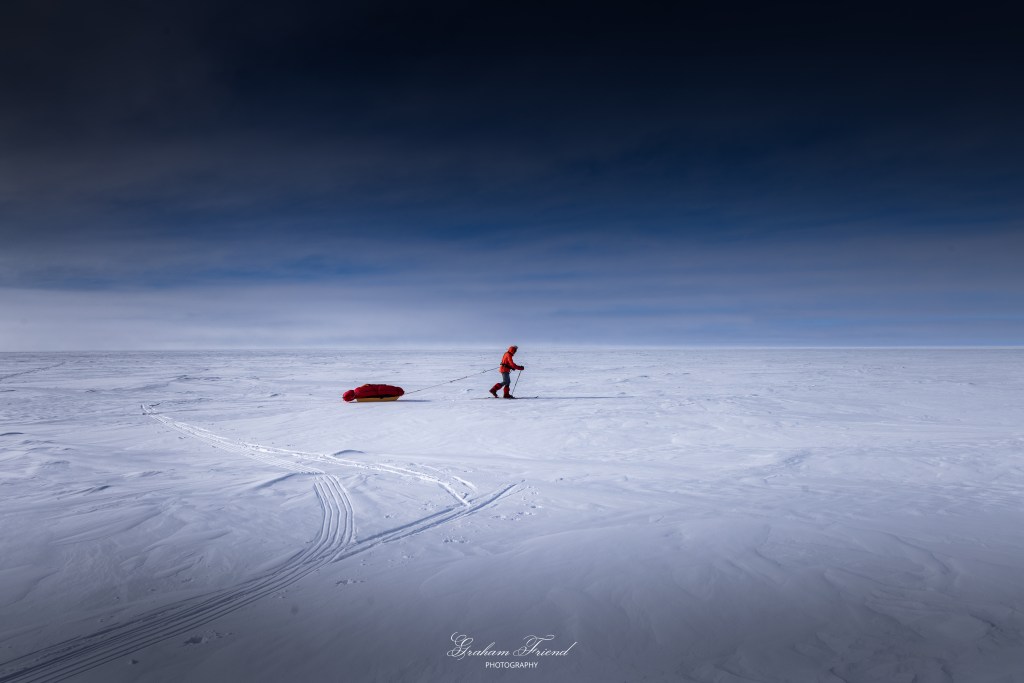
The Last Degree – pulling a pulk from 89 degrees North to the South Pole, a journey of 60 nautical miles, was my main reason for coming on the trip. Vinson was an “add on” and the Last Degree was the thing that really mattered as I am somewhat obsessed with the romantic stories of Scott of the Antarctic and wanted to experience just a little of his tragic journey.
The schedule for flights off the continent meant that if we were not back from the pole before the 18th December we would have to wait until the 30th December for the next flight. This scheduling issue was not made clear to me before I booked the trip in early 2023 and had I known of the risks I would have scheduled the trip for after Christmas – this annoyed me. I could not risk missing the flight on the 18th and so we agreed to curtail the “last degree” to the “last third of a degree” or 20 nautical miles and three nights under canvass. I felt this was a bit pathetic and failed to find another guide who was prepared to try and complete the full distance in the three available days.
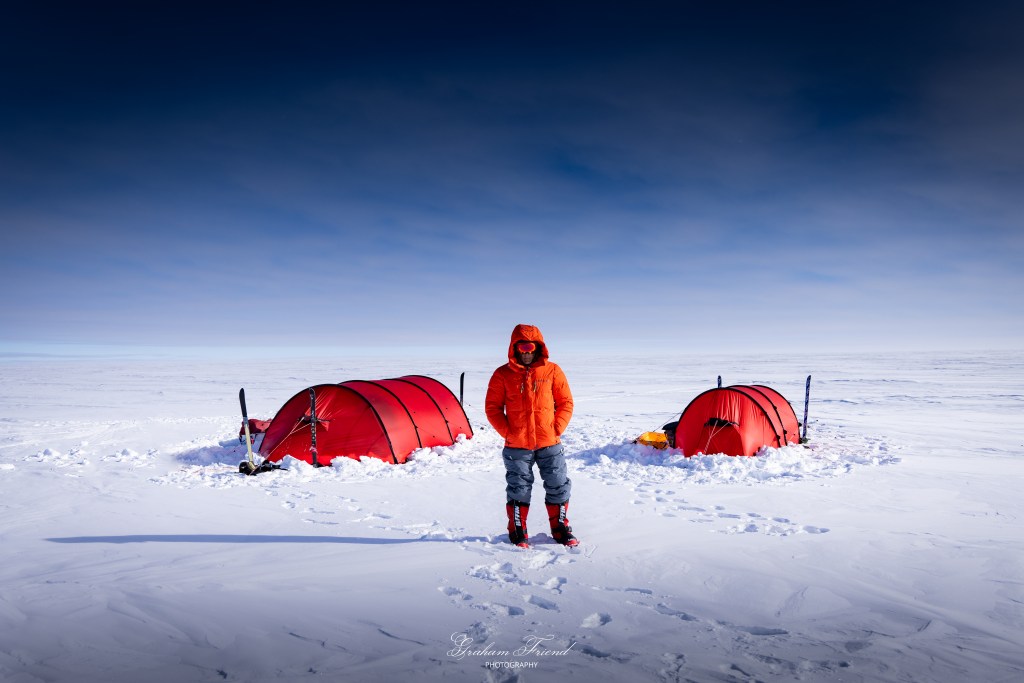
We set off and I was pretty unhappy and frustrated on the first day and would happily have jumped on a skidoo to complete the journey if one was available. However, the next three days were what I had hoped for – being isolated amid the vast expanse of nothing but ice, the extraordinary absence of any trace of life and the simple act of skiing across the polar plateau. It was all over way too soon and, as like most of these things, arriving at the Pole and shooting amusing videos was all very well, it was the journey that I enjoyed.
It was then back to Union Glacier and more sitting around before finally I was able to start the journey home.
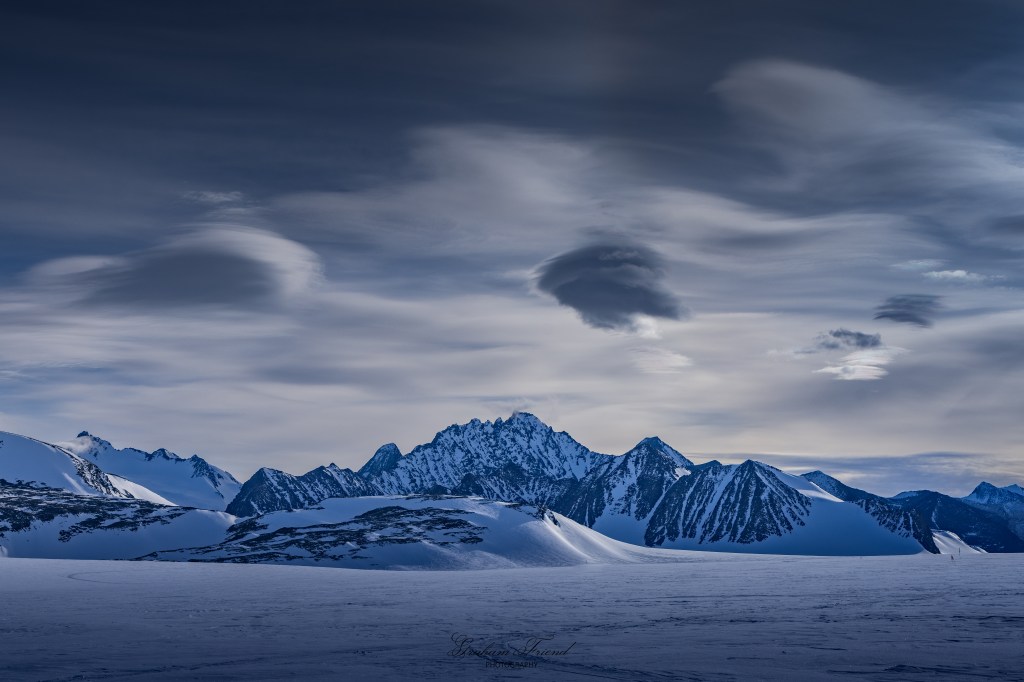
I have been away from home for a month and in that time, I have had 7 days of activity. The rest of the time I have been simply drinking coffee, chatting, eating, attending lectures and watching Netflix and getting fat and unfit – a little like being a typical student (although my student days were not like this). I am sure there will be some who will tell me this is good for me but I felt like I was rotting away. If I had felt like I was standing-still this would have been a good outcome but I felt like I was going backwards. I need continuous forward momentum just to stand still!
I expect this account may appear to many as though I am ungrateful for the amazing experience I have just had. Antarctica is incredible and I feel privileged to have experienced this extraordinary continent. I think my frustration arises for being unlucky with the weather and a lack of transparency from the booking agent over the scheduling of flights which meant that I was not able to have the full experience that I came here for and for which I paid a very high price which is colouring my perception. I did not really achieve any of my three goals – suffering, greater self-knowledge or building new skills. I have however developed the ability to accept better those things that I cannot control which is a good thing and the trip has confirmed that I definitely want to pursue further polar expeditions.
As soon as I was back from the Pole I googled “polar expeditions looking for team mates” and the first one I found was an expedition to recreate Scott’s journey to the South Pole, all 1,387 km of it. I am already talking to Catie about the possibility of joining the expedition and if I do, I think my need for suffering will be fully satiated.
 Expeditions