
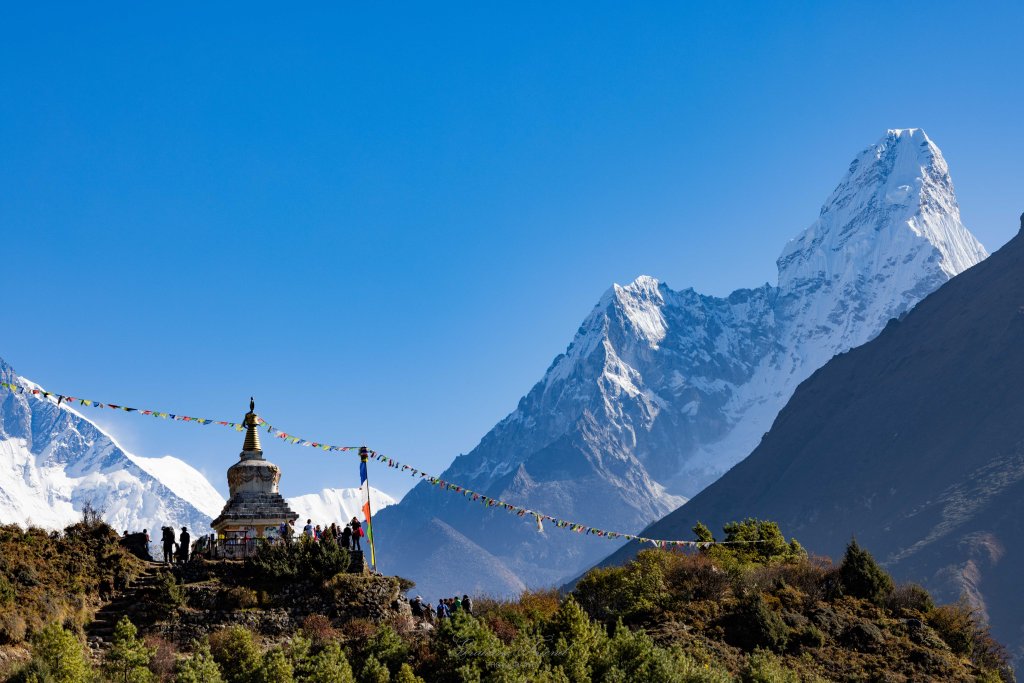
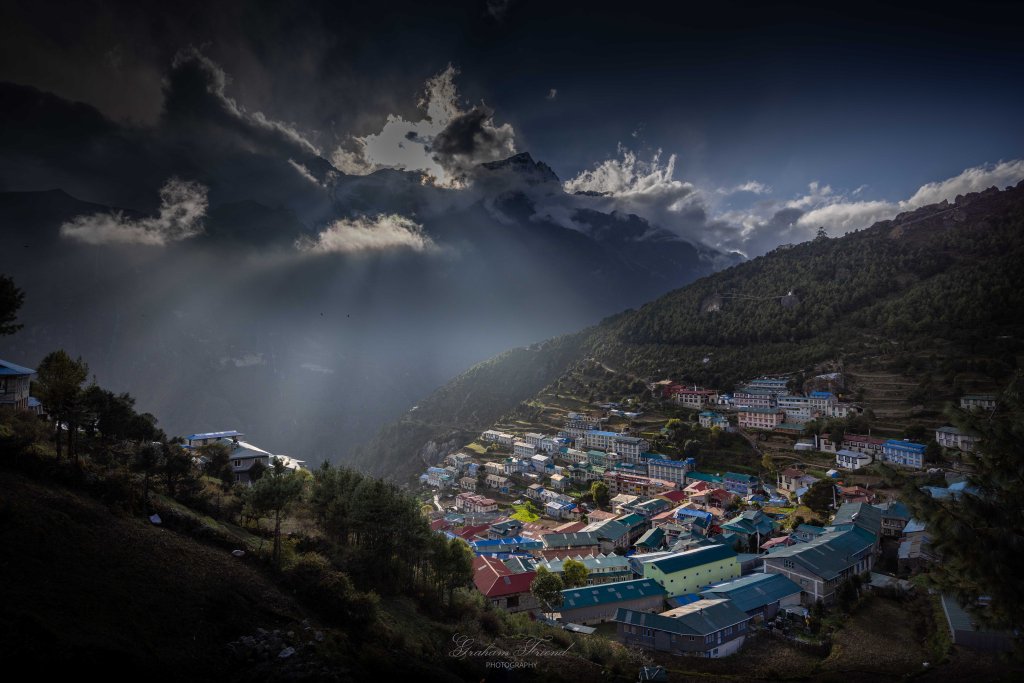
During the trek from Lukla to Ama Dablam (AD) Base Camp (BC) I had developed a stuffy nose which a local had said was due to yak crap mingling with the dust and which, when breathed in, can result in a nasal infection. Well, I don’t know if that is true but I arrived in BC with a head cold which then eventually headed to my chest. I can understand why they call the height above 8,000m the “death zone” as because even at our modest BC at 4,000m plus, my cold, despite resting as much as I could, would not get any better. When we left BC at 7:30am for our summit push I was already feeling weak and my respiratory system was compromised.
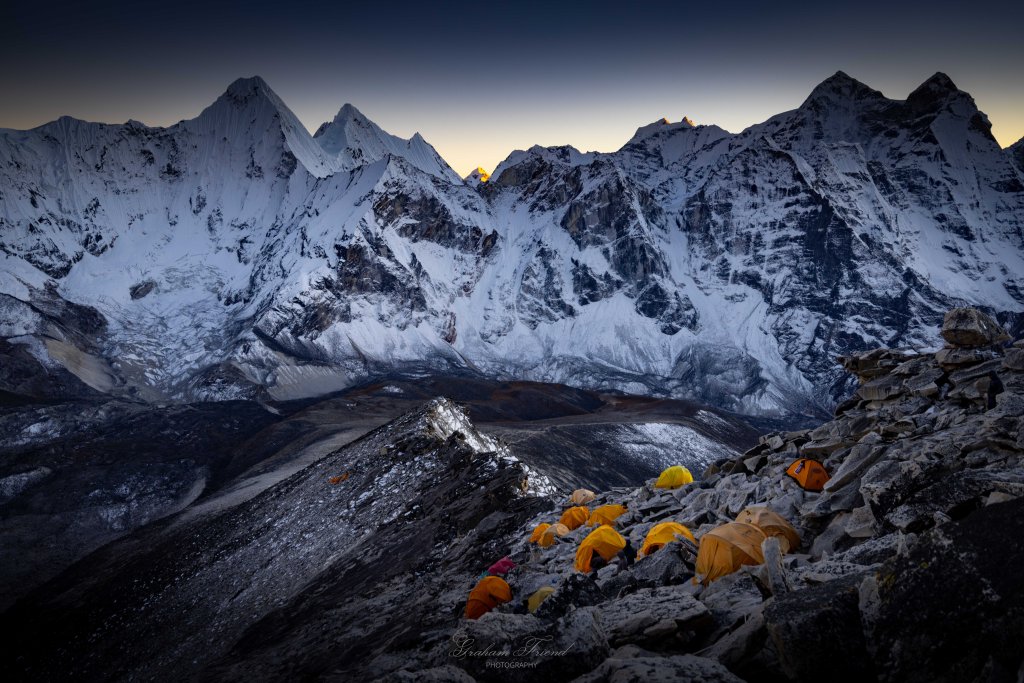
Alan had assured me that after our (only) rotation (forays up the mountain to build acclimatisation to altitude and to stash kit at higher camps) I would find the hike to camp 1 much easier. Unfortunately this was not the case and so I knew from the start the summit push would be a struggle. Fortunately there are no technical difficulties on the way to camp 1, it’s a beautiful and stunning hike.
At camp 1 we switched from hiking to mountaineering gear which we had stashed previously and I put on my 6,000m boots. I suffer from the cold and someone had already been flown off the mountain earlier that week with frost bite (the camp doctor expects him to lose some fingers) so I was not taking any chances. My boots are double skinned, I was wearing heated socks and over the top of the boots I was wearing neoprene gaiters – I am pleased to say that my feet were really warm during the whole climb! In fact, I was really happy with my equipment choices.
My @stellarequipment kit was perfect on the trek to BC and especially upto camp two which was similar to Alpine climbing. At the higher altitudes the expedition trousers coupled with fleece liners were super warm and the guide down jacket was perfect, especially with its two big front pockets where you could fit two Nalgene 0.5l bottles filled with hot water that kept you both warm and avoided your water from freezing. I heard of other climbers suffering as their water froze and they became de-hydrated which can accelerate altitude related health issues. Overall I was really happy with my kit choices, especially as I feel the cold and frost bite was one of my biggest fears. At the highest altitudes I switched to some prescription Cat 4 sunglasses but up to camp 2 my @sungod_basecamp were perfect and fortunately the weather was kind so I did not need to switch to their goggles.
I was accompanied by two guides, one from Switzerland (Alan) and another from Nepal (Nameel), my standing joke for the trip was that one was there to push and the other to pull me up the mountain! Please note I was not aware I would have two guides when I booked the trip! Most people will either have one local guide or be part of a group where a guide is shared. There are many things about the organisation of this trip I would do differently next time and cutting back on the number of guides would be one of them. That said, it was fun to be part of a three man team, to see the differences between Western and Nepali guides and to marvel at how strong the Nepalese Sherpas are. Nameel is only 25 and already has five Everests and other famous mountain summits to his name, but he modestly says that this is nothing and some others his age have much more impressive CVs.
The hike to camp 2 is where the technicalities begin and this section contains what many regard as the crux of the route, the famous “Yellow Tower”, a 15m vertical section of rock. A famous Turkish mountaineer (“Toush” or something like that) had told me in BC that if you can get to camp 2 then you can climb AD. I had already reached camp 2 on our rotation so I was confident I would summit. The first time I climbed the Yellow Tower was a real struggle however, even though I had a thing called a Jumar which should have made life easier.
The route to the summit is protected by a fixed rope which basically snakes the entire way up the mountain starting at camp 1 all the way to the summit. You attach yourself to the fixed rope with a thing called a Jumar which slides easily up the rope, but locks on the way down. In theory, unless you make a mistake with the Jumar, the only things that are going to kill you are avalanches, serac collapses, rock fall, exposure and various high altitude sicknesses such as HAPE (High Altitutde Pulmonary Edeama) and HACE (High Altitude Cerebal Edeama), there are probably a few more, but these are the main ones. So high altitude mountaineering is so much safer than mountaineering in the Alps, at least in theory! Unfortunately these so called “objective dangers,” as well as mistakes (actually the biggest cause of death after avalanche) result in death rates approaching 50% for some of the more treacherous 8,000m peaks.
On my first attempt at the Yellow Tower, no one had taught me how to use the Jumar and so I basically tried to climb with the Jumar on one rope and a hand on another rope and just tried to pull myself up. I was also wearing trainers which made using the feet very hard. In my weakened state this effort had nearly killed me and made me question whether I was capable of climbing this mountain.
During our rest after the rotation I did some training on how to use the Jumar. I was amazed how easy climbing the steepest and smoothest of rock faces with a Jumar is! Why was I not taught this before our first rotation!?
Having spent days fearing the Yellow Tower when we arrived I was actually really looking forward to it. I also decided to climb it rather than Jumar it and other than a section of about 2 metres (Alan did the same), I climbed without pulling on the Jumar which made me very happy, especially as one of my plans for 2023 is the North Face of the Eiger which requires climbing relatively high grades in big boots.
We spent the night at the infamous camp 2 where the tents cling desparately to the side of a rocky outcrop. Fortunately we were able to find the only flat tent in the camp 2 but this stood alone and required mountaineering skills just to get there.
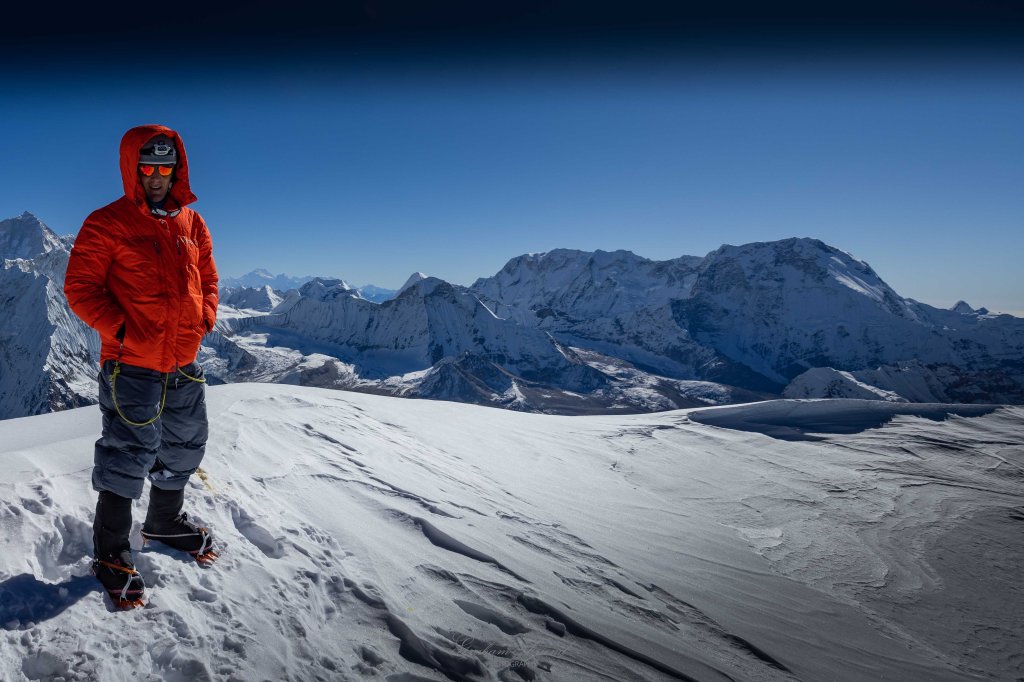
Normally I can always eat but I could only manage a fraction of our freeze dried rations. I slept surprisingly well until midnight when we got ready for our summit push. It was warm, by which I mean not massively cold, and I was slightly disappointed it was not colder so I could really test my expedition trousers and jacket from @stellarequipment who provided me with all my gear (thank you!).
We set off following the fixed rope. Nameel was in front and Alan behind. From the start, AD is relentlessly steep and begins with mixed climbing (rock and snow / ice) and then becomes all snow and ice. Alan at one point thought he might have to turn around as he was losing feeling in his feet from the cold but fortunately I had a spare set of hand warmers and he inserted them between the first and second layers of his boots which worked a treat and these allowed him to continue.
I felt I was working really hard climbing the snowy steps. Climbing at altitude is always going to be hard but I have no idea whether I found it much harder than I should have done due to my cold. Normally, even at 53, I would expect to be aerobically stronger than most and with 60 plus 4,000m Alpine peaks climbed I would expect to be technically stronger than most. To be fair to myself, we were never overtaken and we were constantly having to pass slower parties ahead of us, but I have no real senses of my abilities at high altitude as I was definitely compromised and not climbing in the best of health.
I was finding it so hard that I did doubt whether I would succeed. As always, I thought of Amelie and Tristan, wanting to make them proud and to live the message I always share with them, which is to never give up and that grit and determination are two of the most important characteristics you can possess in life. I disciplined myself to climb to ten slides of the Jumar before resting and with this rhythm, I finally arrived at the summit.
It’s a big, wide safe flat summit and lots of people were milling around, I was slightly surprised there was not someone offering freshly made coffee on the summit. It is something of an anti-climax compared to some Alpine summits but I was glad to have made it. I cannot remember who said it but climbing a mountain is entirely pointless, but meaningful. Summiting Ama Dablam meant something to me.
We then began the descent.
On the way down you hold the same rope and basically climb down with two carabiners clipped into the same fixed rope. The idea being that if you fall you will only fall as far as the next attachment point – this of course could be a nasty and potentially life threatening fall. I would say that descending is probably more risky than ascending. Where the descent is steeper you switch over to abseiling which is not without its own risks, but generally much quicker. Abseiling is one of the most common killers of mountaineers so I was being very careful!
I was making steady progress but finding it tough, I was feeling very weak. We arrived at camp 3 and Alan and Nameel announced that they thought I was showing the first symptoms of HAPE. I just thought I was not on good form, having a bad day and suffering from a cold. To be fair to them, at this point I was coughing quite badly and Alan thought it sounded like I had some fluid on my lungs. Their concerns were that it was a long way to BC or even camp 2 (where we could sleep) and even if HAPE did not develop fully, there was a higher risk of a life threatening fall. If I was part of a “normal group” or this was a race I would have just toughed it out, unless I was incapable of doing so. I expect that as a Western Guide, Alan has a higher “duty of care” and he basically decided I should be helicopter evacuated from camp 3 back to Kathmandu.
There was then an anxious wait to locate a helicopter. Once the decision was made that I should be flown off the hill, the thought of continuing was suddenly very unappealing. This is where mental toughness comes in. The moment there was the possiblity of a helicopter flight to Kathmandu my body decided it could not carry on and suddenly there was no way I could get down on my own! It has been said time and time again that endurance events are 90% in the head and 10% in the body. The moment the mind falters, the body will fail (see my PDG race report for a further example). The secret is to stay strong mentally, the body will look after itself. When I decided to seek qualification for the Ironman World Championshsips, I placed a lot of focus on developing my mental toughness and I have worked on this ever since. I use my kids to keep me mentally strong and to not give up, in any endurance event, they are my secret weapon.
If you have to be evacuated by helicopter, camp 3 is the place to do it as it is a snowy, flat area which meant I did not have to be long-lined (the helicopter lowers a cable which is attached to my climbing harness and you are flown to BC dangling below the heli – I was actually quite excited about this) but can actually climb inside the heli. The heli balanced just on the edge of the snowy plateau and I clambered aboard the hovering helicopter – all very Jason Bourne (but with a runny nose).
All credit to the Nepalese. I was flown to BC, where I had a few minutes to gather all my remaining things which were not distributed across the various camps of AD, before being flown to Lukla. At Lukla, it was a short wait before another helicopter flew me to Kathmandu where an ambulance was waiting to take me to the hospital. I was seen immediately and subject to a battery of tests including chest x-rays, ECG, oxygen levels, urine and blood tests and as normal procedure, was remanded in hospital for observation for the night. The room was fine, with a shower and I quite enjoyed the sounds of the city as I ate an excellent chicken curry.
The specialist high altitude doctor came to see me this morning. After a long and lengthy discussion it was concluded that I had not been suffering from HAPE or HACE but mild Acute Mountain Sickness (AMS) which was compounded by the head and chest cold. The main symptom of AMS is a headache but other symptoms include nausea, vomiting, loss of appetite, fatigue and malaise even at rest, sleep disturbance and dizziness and light headless (source: Wikipedia!). Of the symptoms, I did have a headaches but paracetamol had kept that at bay and I had not really suffered from any of the other symptoms although my sleep has been very poor. AMS typically occurs at any altitude above 2,500m and unless I have been doing a lot of mountaineering in the Alps, I usually get a slight headache when climbing 4,000m peaks. I have probably had mild AMS many times and not called a helicopter!
My feelings regarding the decision to call the heli are mixed. It would have been a tough descent to camp 2, camp 1 or BC but I am used to suffering, in fact I like it – I choose to do it all the time and I would have made it. If I was not with a guide, but semi-autonomous as a member of a larger team, I would just have to have climbed down. Personally, I don’t think I needed a helicopter, but it was not my decision and I can understand why Alan made this choice and sitting in my nice hotel room in Kathmandu, I am glad he did.
I do feel slightly embarassed and a bit of a loser for coming down by heli but not that much, I feel I have sufficient Alpine ascents and descents to my name along with many other examples of suffering to not feel I have anything to prove. Most significantly, in 8 days time I begin the Everest Trail Race which is 6 stages, 170km with a total elevation gain of 26,000m. If someone had said to me at the start – get the big mountain experience, summit Ama Dablam and then we will fly you to a nice hotel in Kathmandu so you can rest and prepare for your race, I would have said, that sounds like a great plan, where do I sign?
I came here to experience high altitude mountaineering: the trek to base camp; staying at tea houses; base camp life and meeting the personailities that inhabit these strangle places; rotations and the “siege” approach to mountaineering rather than the “fast and light” Alpine style that I am used to; testing myself on a demanding mountain; to claim my first Himalayan summit; to gain an advantage in the Everest Trail Race by being well acclimatised; have an interesting story to tell; and to endulge my passion for photography. I have achieved all of these things and so the trip has been a complete success. My only frustration is that I have felt weak throughout and unable to give of my best and properly test myself at high altitude.
Looking ahead, the downside of high altitide mountaineering is, putting the cost to one side, that it takes so long. Three weeks for one “small” summit and up to two months for for 8,000m! In the Alps, you can nail five in a day and be home in time for tea. However, I definitely want to continue with some focused high altitude mountaineering projects. I would like to climb an 8,000m peak in the Himalayas without oxygen and I probably would like to visit Pakistan and climb something big there too, possibly 8,000m provided there is an option with a fatality rate less than 20%. I think that will be enough, the amount of time it takes and the amount of time spent doing nothing, sitting around in BC just does not suit me and my preference for instant gratification. In addition, for my future trips, I plan to use an altitude tent at home whilst sleeping to simulate the higher altitudes and accelerate acclimatisaion which can shorten the time you need to spend away from home (please don’t tell Catie about this tent business).
Despite the relentless head and chest cold it has been a great trip so far. I have eight days to get back to full health as I wait in my hotel in Kathmandu and develop my street photography. This is a genre which I am not very good at and I now have 8 days in which to develop my skills – another blessing Ama Dablam has bestowed upon me. Namaste! (anyone who thinks I am arse, I fully agree – Namaste!)

