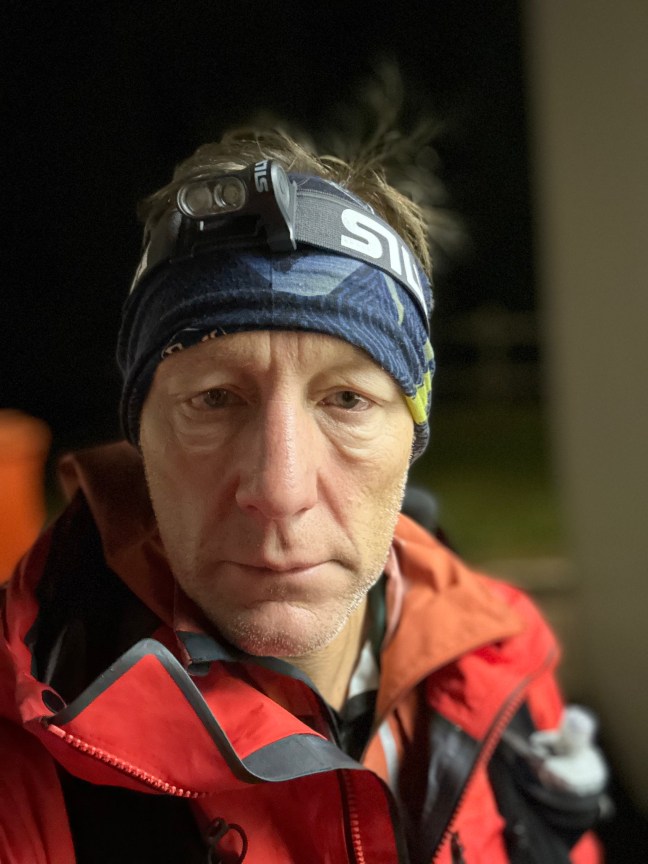
If I had to spend the rest of my life in only one place, it would be at the finishing line of a race. Everyone who crosses the line is a hero, celebrated by friends, family and complete strangers and each finisher is the leading character in their own personal battle with adversity. Emotions run high as young children run hand-in-hand with mum or dad across the line or exhausted athletes fall into the arms of loved ones. Finishing lines are special places.
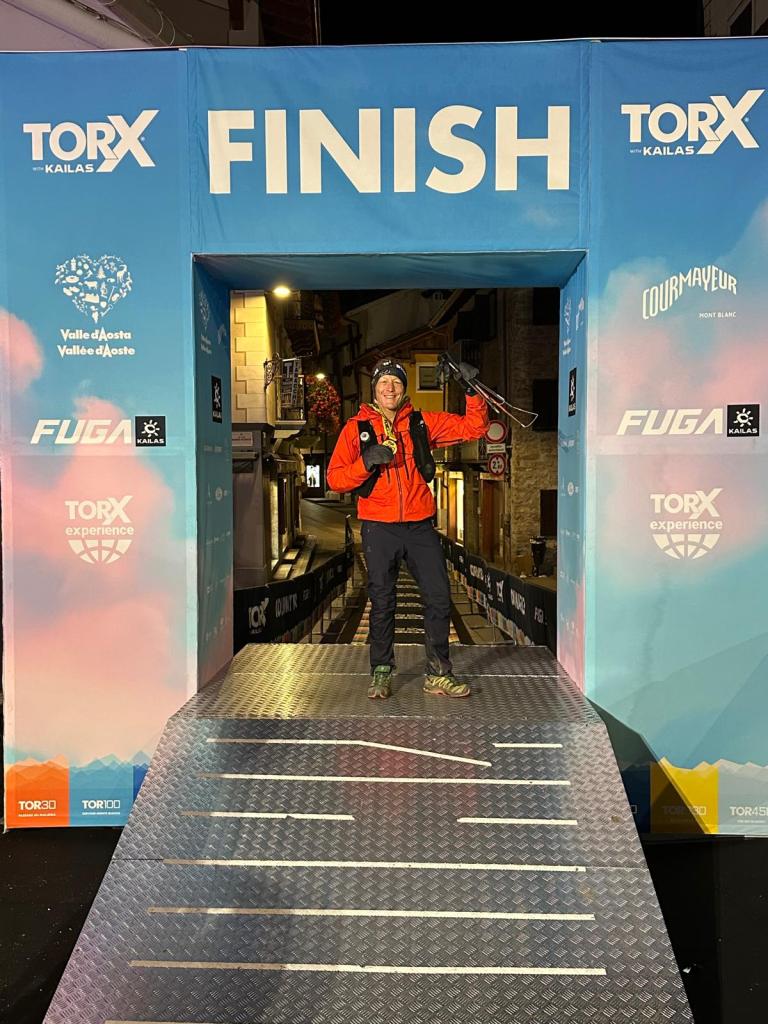
The finishing line of the Tor de Geants in Aosta, Italy was the last finishing line I hoped to cross as a trail runner before hanging up my trail shoes and going back to cycling. Trail running has become too painful and my pace too slow as a result of a ruptured ACL, torn and dislocated meniscus and arthritis in my right knee. A cortisone shot a week before I hoped would be enough to allow me to get across the line one more time.
I had been here last year but pulled out after 110km after suffering a fall and smashing my left knee. I was not too upset at the DNF against my name as I had always been ambivalent about the event as I should have retired from running after the Ultra Trail du Mont Blanc (UTMB) which had been an important goal for me. I arrived this year with the same ambivalence, a lack of consistent training and a few kgs above my race rate but also an ill thought out goal of completing the race in less than 100 hours. It is hard to get your head around the idea of a running race that takes days, not hours to finish, but then, the TDG is no ordinary race.
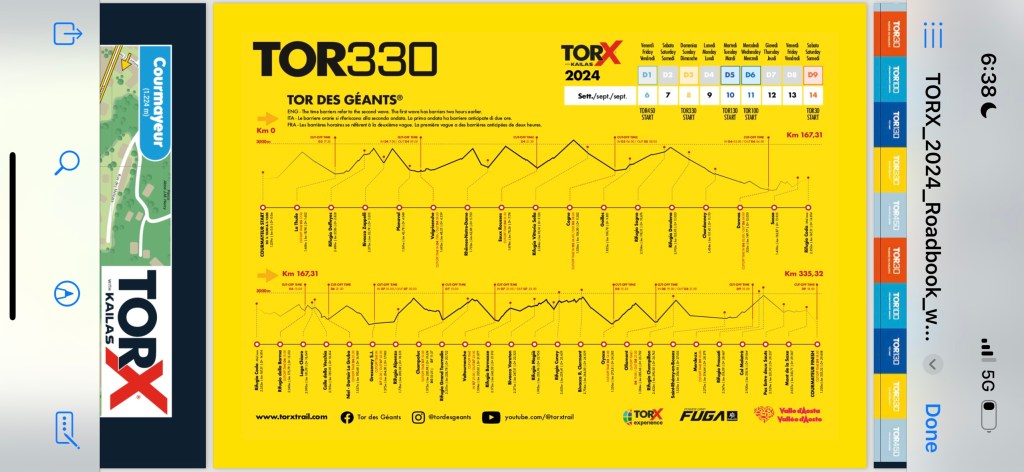
The race concept is that athletes run around the Aosta valley, summiting a series of cols and peaks enroute. The distance is 330km or 205 miles and as they say, 200 milers are the new 100 milers because “everyone has run a 100 miler!” What adds to the challenge is the 29,000m of vertical gain that must be climbed, including passes as high as 3,300m. The altitude further complicates matters as the thinness of the air at altitude makes everything harder and most people begin to suffer altitude issues from around 2,700m. To put this in context, the vertical gain is equivalent to climbing Everest just under three times. Its also 2.6x the vertical ascent of the UTMB which is considered the unofficial worlds championship of ultra trail running.
The race is non-stop and the fastest person to complete the loop that starts and finishes in Courmayeur, wins. There are the usual aid stations you find on races but there are also seven “life bases” where you can gain access to a kit bag, take a shower, have a massage, seek medical attention or potentially sleep. The less you sleep, the faster you can potentially complete the race, so manging sleep deprivation is one of the greatest challenges.
The race is broken down into seven sectors, all separated by a life base. The distance and vertical gain for each sector looks like this.
Valgrisenche 48.55km 4,338m vertical
Cogne 55.45km 4,943m vertical
Donnas 45.77km 2,768m vertical
Gressoney 54.23km 2,470m vertical
Valtournenche 33.62km 3,092m vertical
Ollomont 48.04km 4,652m vertical
Finish Line 49.66km 3,906m vertical
To put these sectors in context, even the smallest days would still be regarded as a challenging ultra race on a stand-alone basis. The TDG is like entering seven really tough ultra races and doing them back-to-back.
My only goal was to complete the race with a performance goal of going under 100 hours. I had arrived that this number with little real thought. It took me 33 hours to run the UTMB and as the TDG is twice as long then the starting point would be 66 hours. I would have to go slower because of the longer distance and there is much more vertical and I am not as fit so I would need to add more time. I added 50% for all these factors and came up with 100 hours. If I had looked at previous rankings, I would have realised that this would have put me in the top 3% of the field which is quite frankly ridiculous.
I stood on the start line ready to face the challenges of distance, vertical, altitude, sleep deprivation and the added complication for this year, terrible weather with sub-zero temperatures and storm level winds.
I raced the first two sectors focused on my 100 hour goal and arrived in Cogne in 32 hours and quickly realised 100 hours was not (was never) achievable. This eliminated my only motivation for being there.
I called Catie and told her I was planning on pulling out. I explained that I did not really care about finishing as I have nothing to prove in terms of my resilience and determination. I had developed a hacking cough (like the entire field) as a result of the extremely cold temperatures on day one and I explained the forecast temperature was going to feel like -18 at altitude, and there was every chance I could end up with pneumonia (although I had bought a lot of good bad weather kit). I even went to see the medical staff hoping they would tell me I was too sick to continue but they said the cough was not an issue. The truth was that it is a really hard race, the first two stages are particularly brutal, but there were no good reasons for actually stopping.
I hung up and was about to head to the admin desk to withdraw when, for some reason I decided I might as well just carry on to Donnas and then decide whether to continue further. Catie also called back as I think she sensed my lack of conviction about pulling out and highlighted that the next stage was (relatively) easy by comparison and was planning to tell me to keep going.
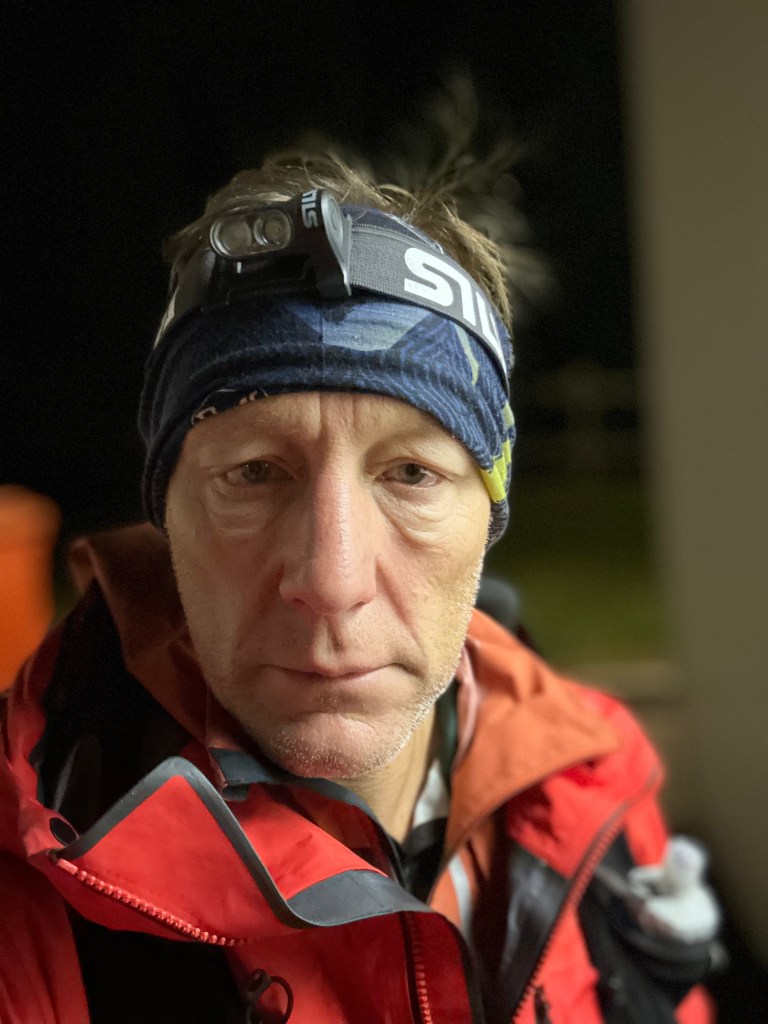
Shortly after, I suddenly started to get lots of messages from friends lending me their support, telling me what an inspiration I was for them and to not pull out, that I had this and could get the job done, etc. I could only glance at them because I had not slept and every time I tried to read an entire message, I started to cry. I resolved to finish the race for my friends.
I have been reading a sports psychology book on mental toughness and resilience and it talks about the importance of having a strong and powerful “why” in ultra races. The emotional maths of ultra racing is simple, the value or importance of your “why” has to be greater than the pain and suffering of racing as otherwise you will DNF (did not finish). My book highlights that performance related goals or “whys” are often not as effective as more experiential or qualitative whys. The moment my performance goal of sub 100 hours was no longer achievable, the emotional maths no longer stacked up – I was ready to quit. In contrast, all of those wonderful messages and the thought of letting down my friends who were now following my little red dot on a map, gave me a powerful and emotionally driven “why”. My “why” was now so strong, as I left the life base for Donnas, it did not even occur to me the possibility that I might not overcome the future challenges.
Chance also played its part in my finishing the race. At one point I ended up discussing with a Brit, an American and a Dutchman which route we should take as the flags were confusing and we ended up running together. We got on well and essentially formed a supportive team which made facing the challenges easier. Ultra running outside of the elites is a team sport. I took to asking others on the course as we briefly moved together, “what is their why” and people shared fascinating and diverse stories.
The race is too long to describe on a stage by stage basis but it is really, really, really hard. Stages are endless, the terrain brutal and the final stage involved summiting a peak in snow, high winds and a temperature of -18 with windchill. My bomb proof why allowed me to cope with it all. Of the 1,085 who started the race, more than half abandoned and took a DNF and 529 crossed the line – I would love to know their “whys”.
The most fascinating thing about this race is sleep deprivation. I completed the race in 138 hours or 5¾ days and during that time I slept for 7 hours (many I spoke to slept for less). It seems I can handle sleep deprivation pretty well. I was really disappointed not to hallucinate. I was generally stable emotionally (although unable to initially read moving motivational messages from friends). A couple of times I felt I was losing my focus, which was a worry as I was descending a technical slope at the time where a fall could have been fatal. I think at one point I fell asleep for a micro second whilst actually walking. The funniest thing was when we were discussing tactics for each stage and trying to work out how long things would take us. Even the most basic of maths was simply beyond the abilities of our brains. Subtracting seven from nine proved challenging for me at one point and I had to ask someone to check my numbers.
I broke the race down into chunks and simply focused on moving from one aid station to the next. “Chunking it down” and just putting one foot in front of the other was all I needed to do. I used a lot of positive self-talk as well which worked – previously I used to tell myself how crap I was and I needed to work harder. I now tell myself what I am doing well and that I could try doing more of it – much more effective.
Suddenly, I was walking through the streets of Courmayeur at 4:00am about to cross the finish line. I was calm, relieved and delighted to receive my medal from Catie and not particularly emotional. I went to the hotel and to bed and later went to the finish line to watch others cross the line.
As I watched the relief, the joy, the hugs and kisses, the stares of young children at their super hero parents, I began to sob uncontrollably. Finally, as my tears subsided, I began to wonder what each finisher had as their “why” and what sort of adventure they had experienced. I love finishing lines and I think we all need more finishing lines in our lives. There will be more finishing lines for me, but no more running races. I am officially retired from trail racing but I am very proud of the lines that I have crossed.
2007 London marathon
2017 Oman desert marathon (165km stage race)
2018 Marathon de Sables (257km stage race, 55th)
2020 Lock-down project, ran sub 3 hour marathon
Costa Rica Coastal Challenge (won age group)
ChaChaCha
2022 Top 50 marathon des sables
Pierre Menta Ete 3 day trail race
Finished 334th in Ultra Trail de Mont Blanc
Everest trail race (250km trail race) (5th Veteran)
2023 Monte Rosa Sky marathon
187 km Menorca trail race
2024 Trail de Verbier Grand St Bernad
Tor de Geants
 Expeditions