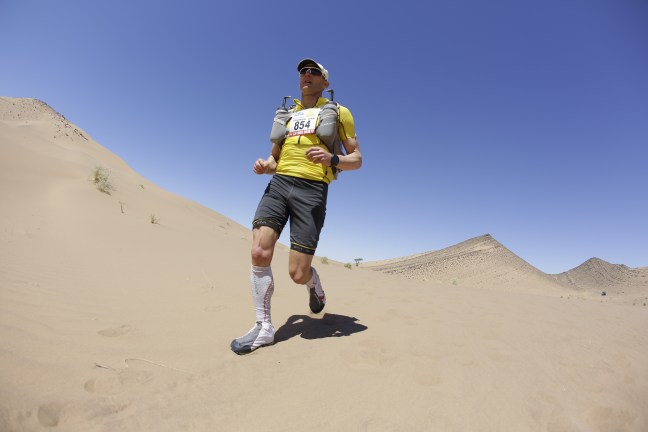
I completed the Marathon des Sables (MDS) in 2018 and said I would only do it again if someone I cared about wanted to race. Catie decided she wanted to race so we both signed up. Shortly after she developed hip issues and was told by the specialist that “you can do it but it will be the last thing you do” and so she had little choice but to pull out. I was on my own.
In 2018 I had targeted a top 50 spot but finished 65th after suffering stomach and groin issues which meant I had a bad day 2 – I had something to prove. My initial build up had been good, combining skimo with running, but a month in hotels prior to the start of the race meant I had put on weight and dropped from my peak. I planned to do my best but was still targeting top 50 overall including the elites.
The race covers 250 km over 6 stages through the heat, sand dunes, rocky ridges and dried out riverbeds and lakes and the gorges of the Sahara in Morocco. The race is self-sufficient with runners required to carry everything for the week, including food, the organisation only provides so called “tents” and water.
The sensible thing to do on Stage 1 (30,3km) is to start gently and not got out too hard. I went out really hard with the idea of counting when 50 people had passed me and then trying to hold position. The first stage is relatively easy, not too much sand, not too many dunes and conditions were kind with moderate temperatures and there was little wind. Predictably enough I faded badly in the final kilometres but it was enough to finish in 40th position within circa 1,000 starters and 5th in my age category in a time of 3 hours and 4 minutes. I was happy with the result but it had required a big effort and I was worried about the damage I had done for the remaining stages.
The thing that makes the MDS is the camaraderie that develops amongst your tent mates which are drawn from a surprisingly random and wide selection of the population. I was sharing with a group of four men including a robotics engineer, a former royal marine commando and entrepreneurial old university friend of Catie’s and a lawyer based in New York. Everyone was respectful, considerate, supportive and I was probably the most annoying of us all. They often say if you cannot spot the idiot in the group, then its probably you! I tried to be the best tent mate I could and not too much of an arse!
Stage 1 is generally considered to be “easy” and Stage 2 the first real test. The 2nd stage was 38.5km and comprised a lot more sand much more climbing. After yesterday I had no choice but to set off at a steady pace and I just had to hope my base fitness and base speed would be enough. After finishing 335th last year this was the stage I feared. I felt ok and just ran steadily, drafting with my tent mate Jonathan into the tough head wind. I had never appreciated how much of a difference drafting makes when running and we rotated 2 minutes on, 2 minutes off and it worked really well. We overhauled quite a few people but focusing on the drafting I had neglected my hydration.
I reached the second checkpoint and was in a bad way due to dehydration. I was disorientated, confused and feint but managed to blag my way through the check point and not get pulled out. In my confused state I thought the end was just a few kilometres away and was surprised how much race food I had left. I ate it all and headed off only to discover from another runner there was a hard 10km left to race. I was in a bad way and had to ration my few remaining jelly babies. I would eat half a baby every 20 minutes and would try and keep the sugar in my mouth for as long as possible to create an extended “carbo rinsing” effect.
The course headed into the dunes which we had to cross before an endless steep and rocky climb – it was hell. The sandy descent was fun and fast and there was only 3km from the final checkpoint. At this point a sandstorm hit and it felt like running into a brick wall, sand stinging my bare legs, arms, face and eyes. I was on fumes and telling myself I only had to make it to the next marker (which were hard to see in the storm). I finally finished the stage and was surprised to cross in 38th place and 5th again in my age category and to have moved up to 36th overall. I was relieved to have actually delivered a good performance despite going hard yesterday and not looking after myself well during the stage. It helped my confidence.
Two years or so ago I learnt that I had a broken back and that one of my vertebrae has snapped off my spine and now compresses my sciatic nerve. I can generally manage the pain although sometimes I cannot walk 100m but one thing that is now impossible is sleeping. I naturally sleep on either my front or back but this exacerbates the pressure on my sciatic nerve and so I can only attempt some sleep lying on my side. I had found an inflatable mattress that allowed some level of comfort but I was paranoid about puncturing it on the rug that covers the hard floor of the desert upon which we sleep. Despite sweeping the rug with my hand and using my space blanket as a groundsheet, I managed to puncture my mattress on the first night.
Nights were torture, it took about 45 minutes for the mat to deflate sufficiently before my hip would hit the stony ground, cause pain and wake me up. I would then have to blow up the mat and repeat the process throughout the night. What makes the MDS so hard is the lack of food (as you cannot carry all that you need) and the retched sleep.
Stage 3 was the most technical of the race and suited me. I was determined to manage my nutrition, hydration and effort well so that I could finish strongly. I started very steadily and we were straight into a climb and then a technical descent. Living in the mountains and trail running in the Alps paid handsome dividends and I danced and floated past many people within the first few kilometres. I then recruited an Irish chap to draft with and we used the 2-minute method to cross the valley floor. There was then another technical ascent followed by ridge running with spectacular views to either side – I flew past many more runners. A sandy descent took us back to the valley floor and I hitched a ride with one of the top Moroccan women who shielded me from the wind and refused my offers to take my turn on the front. A strong woman.
There was then a final, sandy climb which was only possible to ascend with the use of a fixed rope before a fast descent and a final flat 7km to the finish. Another sandstorm began and it was another battle to reach the finish line. Much of the time it was not possible to see more than 100m and so I just kept running hoping I was vaguely heading in the right direction. Finally, the finishers’ arch appeared and I crossed the line in 37th place and retained my 36th position overall.
Despite my best efforts I had not been able to fix the puncture in my mattress. To add to my woes, the sandstorm on day 2 had resulted in what the race doctors would later tell me they believed was a scratched cornea. Closing my right eye was painful and further added to the misery of the night. I was reconciled to a long and sleepless night ahead of the “dreaded” long stage.
Stage 4 had gone well in 2018 where a strategy of walking the first 40km and running the second 40km had yielded a 40th position. As it was the same course, I persuaded Jonathan to join me in the same strategy. I unfortunately became a victim of my own success. The top 50 athletes, the so called “elites” start 3 hours after the rest of the field. We were keeping intimidating company. We started and the pack went off really hard, we were literally the last in the field. We walked (fast) as planned but at 40km it stilly sandy and now dark. The scratched cornea meant I could not wear my contact lenses as planned and as Johnathan had damaged his eye as a child, we were literally the blind leading the blind, in the dark through the desert. We could barely make out the illuminated course markers let alone where the harder (and therefore faster) sand was and so were unable to run. It was only in the last 15km where we could implement part two of the strategy which was to run hard. We were running fast and feeling fresh but there was not enough race left to make the strategy work. As we approached the line we agreed that we had executed our strategy really well, but as we were to discover, it was the wrong strategy. I finished 96th and many people who I knew to be weaker runners had put one or even two hours into me. My overall position dropped from 36th to 51st and I had lost an enviable position in the overall classification.
During the rest day I sacrificed a bottle of water to locate the puncture on my mat and was surprised that the patch I bought with me actually worked. The race doctors also provided me with pain killers for my eye and so I finally had a reasonable night’s sleep.
Waking for the final timed stage I felt the pressure of knowing that I would have to deliver the run of my life to recapture my top 50 position. On the final stage everyone is either running hard to defend their position or, like me, running hard to gain their desired position. Being late in the race, margins were now quite wide and so I would need to deliver a really fast marathon to climb back up the general classification.
The stage started and I went off hard with the leading runners knowing this was a risky plan. Eventually the pace settled and I found myself in a fast group of three and we shared the work into a stiff headwind. The first 20km was fast terrain and as other runners came by the group fragmented and I found myself isolated. I faced a choice, I could either put in a huge effort to get back on to the small group ahead or reconcile myself to failing to reach my goal as a solo run would be much slower. I found the mental strength to turn away from the “easy” option and I put in a huge solo effort to join the group ahead. I reached them and was able to cling on whilst my breathing and heart rate returned to something manageable.
Eventually this group fragmented but I found myself running with a chap called Douglas and he was comfortable with me just sitting in his wind shadow. We ran tactically, using faster runners as they came past us to move up but then dropping off if the pace put us into oxygen deficit. Johnathan, who was dropped early, also clawed his way back to us just as we reached the crux of the stage – 10km of dunes. Douglas was our eyes and charted a brilliant route through the dunes contouring along the ridges and finding the hard and fast sand. As the dunes subsided, we were into the final fast 10km to the finish. Despite having run hard all week I still had enough to take the lead and begin pushing to reel in a few of the runners who had passed us earlier. We picked off two or three runners and the finishing arch began to loom ahead just as I began to fade. Johnathan pushed me to find something more as every second would count and I tapped into the idea of setting an example in terms of grit, determination and perseverance that I was setting for Amelie and Tristan. They are my secret weapon and I found something to push hard over the finish line.
We delivered a four-hour marathon through large dunes after a week of racing and this was enough to deliver my best position of the week at 33rd. It was an agonising wait for the final cumulative results to be published to see if it was enough. Finally, the wait was over and I had done it, 47th in the Marathon des Sables. The final marathon stage is probably one of the top three athletic performances of which I am most proud; my qualifiers for the GB triathlon age group team and the Ironman World Champs in Kona being the two others.
The biggest challenge now is to leave the goalposts where they are. My goal was to reach the top 50 of the MDS at the grand age of 52 and I did it! Inevitably I have asked some “what ifs”. If I had not made a tactical error on the long day and not lost 1 to 2 hours, I would still be sitting in the mid 30’s. Perhaps if the final month was not spent in hotels and I arrived at my peak I might have been able to find a few more places. The truth is that I pretty much delivered the best result I am capable of, I believe that my fitness level is consistent with a mid 30’s rank in the MDS and I am unlikely to ever better this. Most importantly, I have nothing more to prove in regards the MDS. I would however come back again if Tristan or Amelie wanted to do the race. Tristan has already said that when he turns 16 and meets the minimum age requirement, he would like to do the race and I hope that Amelie would also join me at some stage. Whilst a terrible cliché, this event is life changing for many of the adult participants, opening their eyes to what they are capable of. I cannot imagine what completing the MDS might do to the self-belief of a teenager and the bigger dreams that it might conjure.
 Expeditions