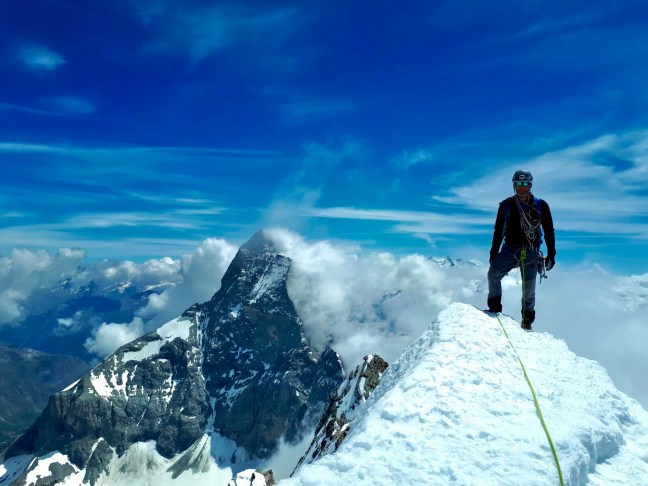
Just getting to the Aosta Hut, our support base for the Dent D’Herens, was a mission. A twisting Italian mountain road took me to the Place Moulin Dam. From there, I road Catie’s “shopping bike” to the end of lake (5km) along a day-tripper strewn and rocky path that nearly destroyed her bike before chaining it to a tree. I then began the 8km hike to the hut along an endless valley before scrambling up the steep and slippery moraine to a small, shabby hut. My heavy pack bit into my shoulders as I was carrying the kit for both Sebastian and me.

I hiked in alone as Sebastian was on another mountaineering trip. A series of issues meant that he did not begin the journey to the hut until late evening. It was not until around 11pm that I finally spotted his head torch at the start of the valley – a good two hours out. When I checked again 30 minutes later the valley was engulfed in thick cloud – I worried for his route finding and safety. I said to myself that if he were not at the hut by 1:00am I would go out in search for him. Fortunately, when I woke again to check, he was making the final steps up the path to the hut. He looked shattered and the news that breakfast was in an hour and half at 2:30am did little to help.
At around 3:00am we began the walk up the glacier. Sebastian wanted to attempt the East and West ridge traverse of the Dent D’Herens – a big project for us under normal conditions of rest and recuperation. I offered the suggestion of just tackling the Western ridge and that I would take the lead but he said he felt good enough to tackle the full mission. Sebastian usually sets a good pace, but this morning he was definitely suffering from the previous long day.
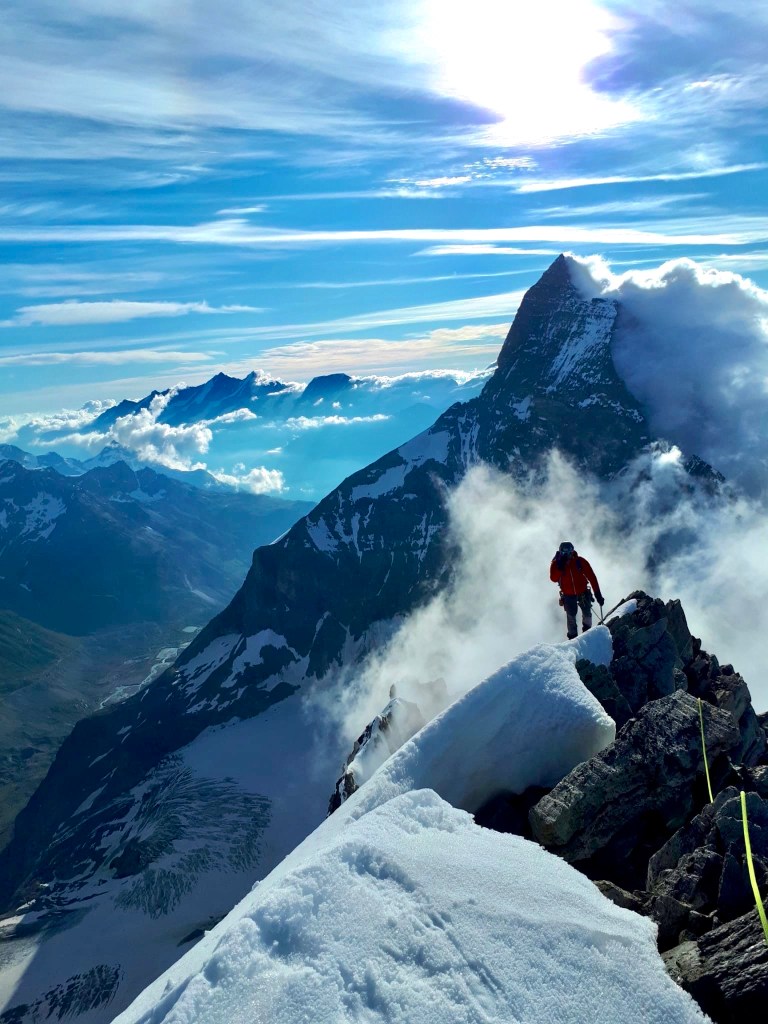
We arrived at the East Ridge and began our climb. When we reached the ridge, we had a spectacular view of the Matterhorn as the sun rose from behind, highlighting its very own, personal weather system generating billowing clouds to the South. The guidebooks suggest that the only reason many climb the Dent D’Herens is to gaze across at the Matterhorn.
The East Ridge was horrible – the rock is described as friable which means easily broken, flaky, loose and constantly breaking off – imagine an old, crumbly block of cheddar cheese. I am astonished the mountain has simply not collapsed into a small pile of rubble so loose and flaky was the rock. Flaky rock means it’s really hard to find ways of protecting yourselves from a fall and lacking the experience of guides, we were definitely at a heightened level of risk. The route also involved walking on narrow ridges made of flaky, unstable rock in crampons with death on either side and with limited chance of Sebastian, or any protection he placed in the fragile rock, saving a fall. Whilst I now embrace a snowy ridge, this terrain still terrifies me. I felt no need to prove myself to the watching Matterhorn – I got on my hands and knees and crawled.
Sebastian led and I followed and we tried to look after ourselves – it did not help that there were no obvious bolts or stakes marking the route and so we never knew if we were following the correct route. Eventually we began to approach the summit and we paused for the last rocky section before a snowy arret.

Sebastian went to stow his ice axe under the strap of his rucksack, a standard mountaineering tactic. I watched in slow motion as he managed to somehow miss the strap and carefully let his ice axe slow slide down his back. I even had time to call out “ice axe” before it hit the rock, bounced and then went flying down the South Face. Crashing and spinning we watched helplessly and it seemed like an eternity before it finally disappeared from view and into the glacier below. I found myself thinking morbidly about how long it would take if you were to fall before you finally found your own, final resting place, deep in the glacial ice. Sebastian was thinking about how the hell he was going to get off the mountain safely.
We finally arrived at the summit – many hours behind schedule. Sebastian found a dagger shaped piece of rock and planned to use this as a potential breaking device on the snow – I doubted its efficacy. We began our descent, I short roped Sebastian on the snowy shoulder before the Western Rocky Ridge and we arrived safely to find a Spanish couple on the start of the rocky section.
Sebastian speaks fluent German, English, Italian and French so for once, I was delighted to be the official spokesman for our team. The husband had a second ice axe which he kindly lent to Sebastian and suggested we benefit from his 70m rope for the 7 stage abseil to the glacier below and the path back to the hut. Sebastian wanted to continue on the ridge, I wanted to practice abseiling and it felt slightly uncharitable to decline their offer given the loan of the ice axe, so we agreed to rappel together.

The husband was a character: from Madrid; former military; loud; extrovert, heavily accented and almost unintelligible and somewhat cavalier in his approach to safety. I was already beginning to regret not following Sebastian’s suggestion of descending by the ridge and down climbing.
Abseiling is one of the most common causes of fatalities amongst mountaineers and one of the most common causes of abseiling fatalities is descending on rope strands of different lengths. To reduce the risk of slipping off one end of the rope and falling like an ice axe, it is standard practice to tie a knot in each end of the rope (in Touching the Void, Joe Simpson, when abseiling into the pitch dark of a crevasse, decides not to tie a knot because if his rope is not long enough to reach the bottom of the crevasse, he would rather a quick death than die slowly and painfully at the end of a rope). It took all my Spanish and charm to persuade the Spaniard to tie a not – he clearly thought such a thing was for sissy’s.
We began the series of 20 to 30m abseils and all was fine – the four of us were hanging on the side of the mountain by two mettle bolts, when the rope got stuck as we tried to pull it down for the next abseil. The Spaniard began pulling wildly on the rope to try and free it but in doing, sent a cascade of the loose, slate like rock, tumbling towards us. I saw a good sized, spinning slab of rock heading straight for me and just in time I leant into the rock and bent my head and thankfully received only a glancing blow to the back of the helmet – a second later and it would have sliced my face in two.

We made it to the glacier without further excitement and were relieved to still be alive as we headed for the hut to collect our stashed hiking clothes. We then hiked back out to the end of the damn, collected our bikes and cycled to the car park. The total mission took 16 hours on today I am fairly broken. As I reflect on the trip my insights are to keep away from crazy Spaniards and abseil only if you have to!
 Expeditions