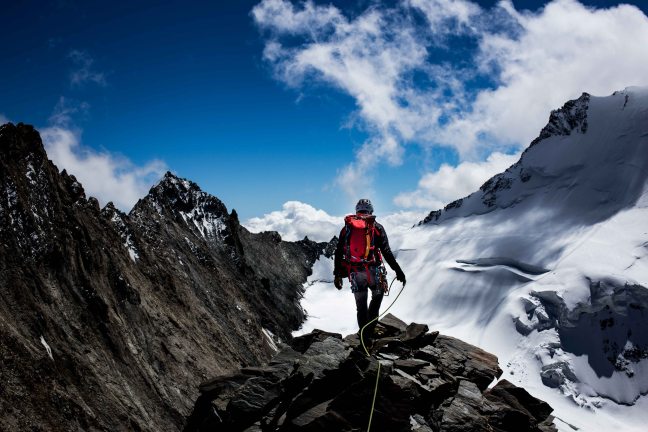
Mountaineering partnerships are like marriages and like any successful marriage, being able to communicate openly, honestly and early is key. Sebastian and I had encountered some communication issues on our latest adventure which we discussed and which will make us a more effective partnership going forward.
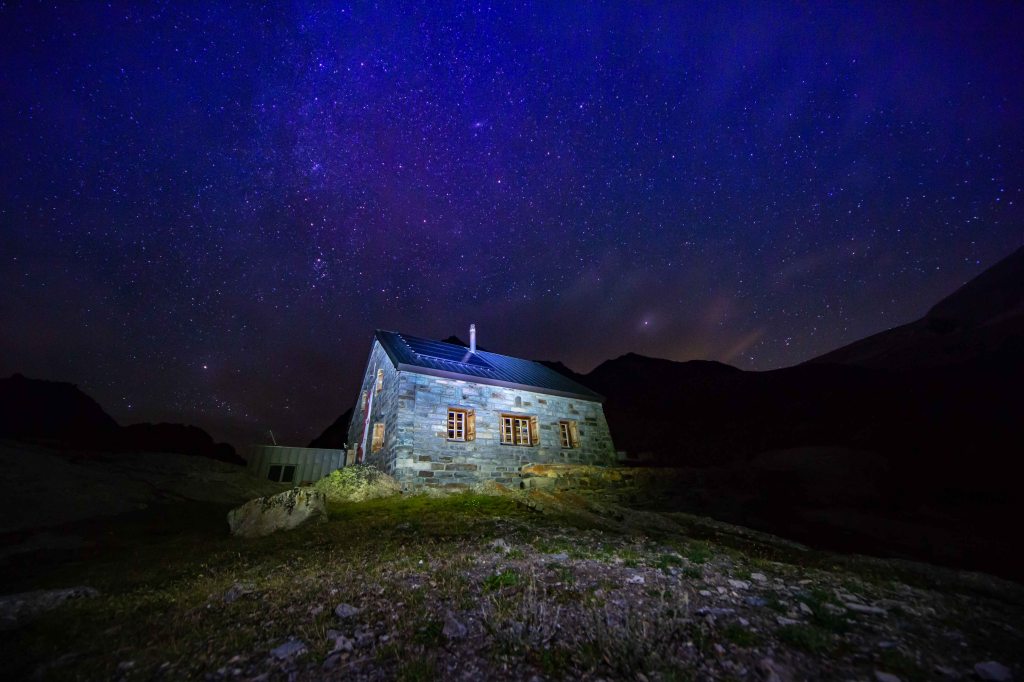
The summer weather has been so unsettled this year and we had been watching the forecast for days and it looked like there was a window, albeit a narrow one, to attempt five 4,000m peaks over two days. As we had left it so late to decide to go there was only one place left in the Bordier Hut which I took and Sebastian gallantly agreed to carry up his camping kit and spend the night under the stars.

Sebastian had been mountaineering all week and so, whilst acclimatised, he was carrying a fair amount of fatigue in his legs and had to carry his camping gear. I had returned to trail running the day before and biking and I was also a little tired but had not been at altitude for a while. Despite the fatigue we made it to the hut in 3 hours and it was satisfying to beat the guidebook’s suggestion of 4 to 4.5 hours of ascent.
I am currently obsessed with star photography and so I set my alarm clock for an hour before the 2:00am breakfast to try and get some shots. I experimented with “painting” the hut in light with my headtorch during the long exposures and it seemed to work fairly well.
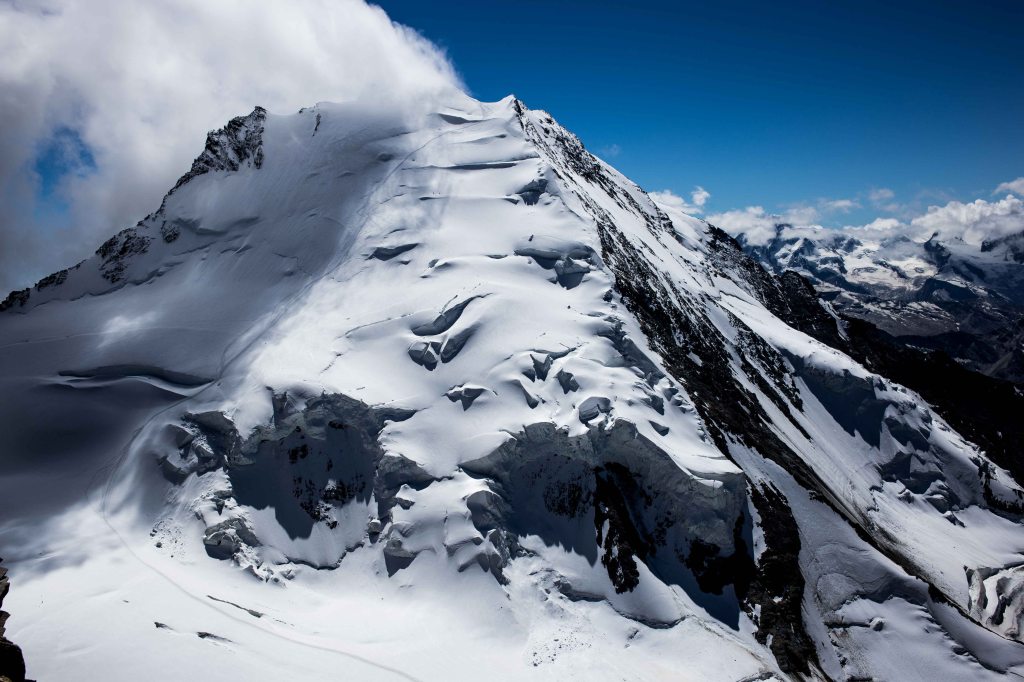
Climate change is impacting mountaineering . Some routes, which were once possible, are now too dangerous because the ice that keeps some of these mountains together has melted so much that rockfall has turned the access couloirs into bowling alleys with hapless mountaineers playing the role of the pins. To gain access to our target summits we had to take a long and tedious detour which added a good couple of hours to our journey. As we trudged along, we wondered whether my children and (hopefully) grandchildren would still be able to enjoy the mountains in the same way.
Some people are born with an over developed sense of competitiveness and I fall into that category – as anyone who has ever biked, hiked, sailed or stood in a supermarket queue with me knows, I do not like being overtaken. Sebastian and I were overtaken by a couple of parties on the hike to the start of the ridge and this upset me a great deal.
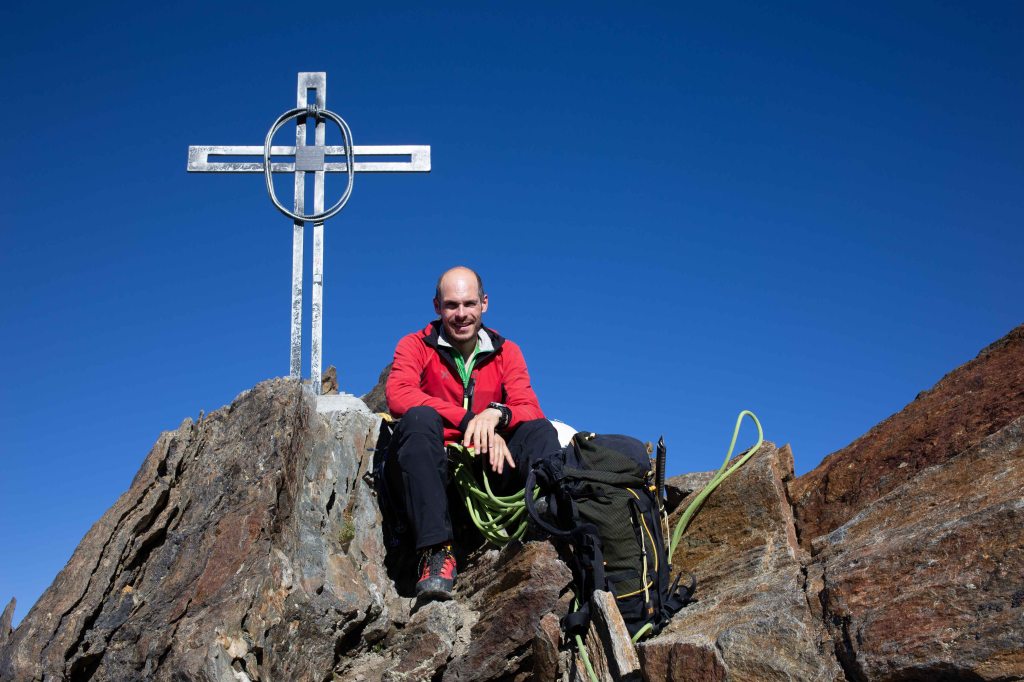
It took for ever to reach the Hobarghorn even though we were moving more effectively together than previous trips. This was partly due to our breaking of the cardinal rule of “never leave the ridge.” My usual guide, Bertrand, had told me that it is almost always best to stay on the ridge – for one, if you are on top of the ridge, other climbers cannot send rocks down on top of your head and secondly, those inviting, easier looking routes off to the slide often end in a sheer drop. A challenging looking section on the ridge prompted us to take an easier looking line to the side which resulted in a difficult and time consuming detour before finally regaining the ridge an hour later – we agreed to adopt the mantra “never leave the ridge”. Finally, we reached our first summit, the Dirruhorn.
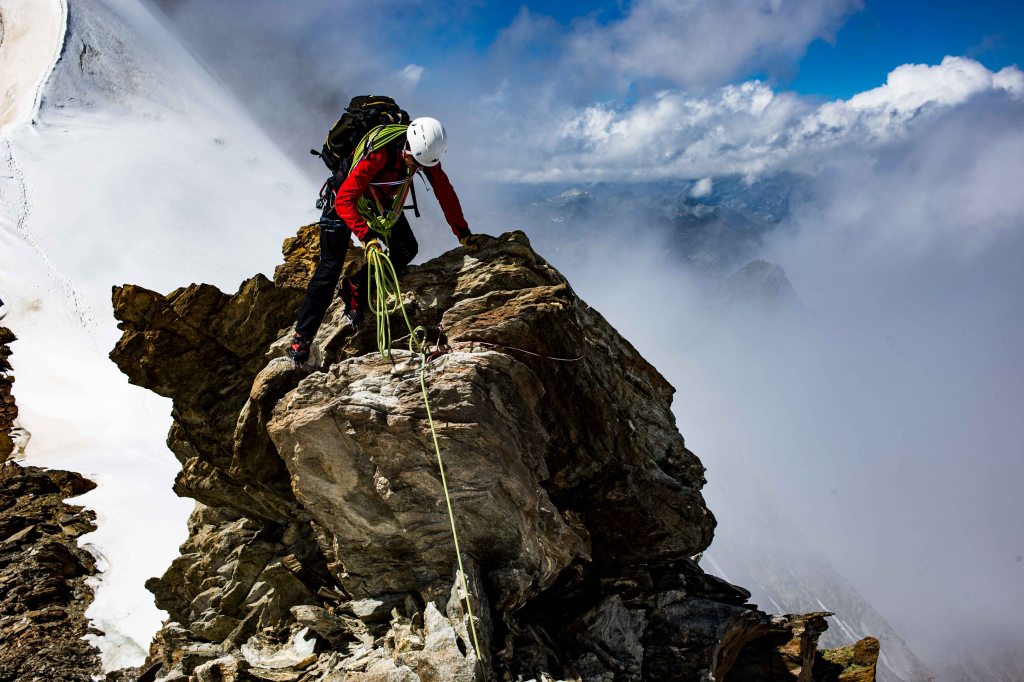
The next peak awaited. Communication can be difficult when your partner is a rope length away, the wind is blowing and there is a mountain between you – its not a bad metaphor for married life. Sebastian led most of the time and had found himself in a precarious position, hanging off a ledge with not a lot below him. He needed slack in the rope to reach safety but the rope had snagged and was stuck. He shouted for rope but I could not hear and it was only after his calls became louder and more desperate that I understood what he wanted. I left the safety of my resting point to climb up and free the rope and we were able to complete the second summit, the Hobarghorn.
On the final summit I took the lead as not only did I want the practice but I had also learnt that the best mountaineering photos are usually taken when shooting down rather than up. Shooting as the “second” on a mountain simply results in endless photos of your partners arse which is never a good look. I felt confident on the ridge, enjoyed leading and managed to get some better shots. We made it to our final summit, the Stecknadelhorn.

We began the descent down the snowy ridge from the base of the Nadelhorn on our way to the Mischabel Hut. An ongoing debate between Sebastian and I is the roping strategy we should adopt on snowy ridges. There are no real “rules” in mountaineering, just a series of judgements. There comes a point where you cannot “self-arrest” a fall as a rope party in which case there is an argument for un-roping so that if one person falls then only one person dies. The counter to this argument is that if you cannot self-arrest then some form of protection should be put in place, such as stakes which you carry and hammer into the ridge. However, the stakes are heavy and the process is time consuming and whilst this approach is often employed in the Himalayas, it is seldom if ever used in the Alps. Most parties in the Alps (or at least this is what I have observed) remain roped up on ridges and this is where the Guides come in. Guides are not allowed to fall and so they are the “protection”. However, what do you do if you do not have a Guide with you? It’s a difficult one… the debate continues.
We made it safely down the ridge and arrived at hut just before dinner – a massive fifteen-hour effort although much slower than we should be although we were not the last. At dinner the Guardian of the hut asked us if there was a group behind us as they had not yet returned, it was getting dark and everyone was getting worried. They called up mountain rescue and a helicopter was sent up to look for them. The following morning, we learnt that they had made it safely back but they had just been very slow – we wondered if they would get a bill for the heli.

Over dinner we checked the weather and thunder storms were forecast for the afternoon on the Lenspitze, our target for the following day. A fast and confident party could expect to beat the storm but Sebastian and I know that we are not yet at that stage yet. We made the call to abandon, knowing that this almost guaranteed the weather would be perfect tomorrow!
We set off for the return home and were passed by “runners” in shorts, t-shirts, running shoes with elasticated crampons and light packs – this is something I want to do. We had a very pleasant stroll across the glacier after a very late breakfast (6:30am) and marvelled at the stunning scenery. Things became more challenging as the glacier became ever more crevassed – in fact it became something of a maze and I have never had to navigate something like this before. I was in the lead and enjoyed the challenge of threading my way through.
Whenever I had to cross a big gap or what looked like a weak snow bridge (an accumulation of snow sufficiently deep to hopefully walk on) I would call out “crevasse” and Sebastian would put a bit more tension in the rope in case the bridge collapsed. I would then continue and occasionally would pause to work out where to go next. Depending on how far I had continued this might mean that Sebastian found himself being forced to stop on the bridge in order to maintain some tension in the rope. As the leader its quite hard to gauge when you have travelled 25 metres or even to see if your partner has safely navigated the crevasse and I could tell by Sebastian’s tone that this was causing him some frustration. I tried to keep this in mind but it was hard.
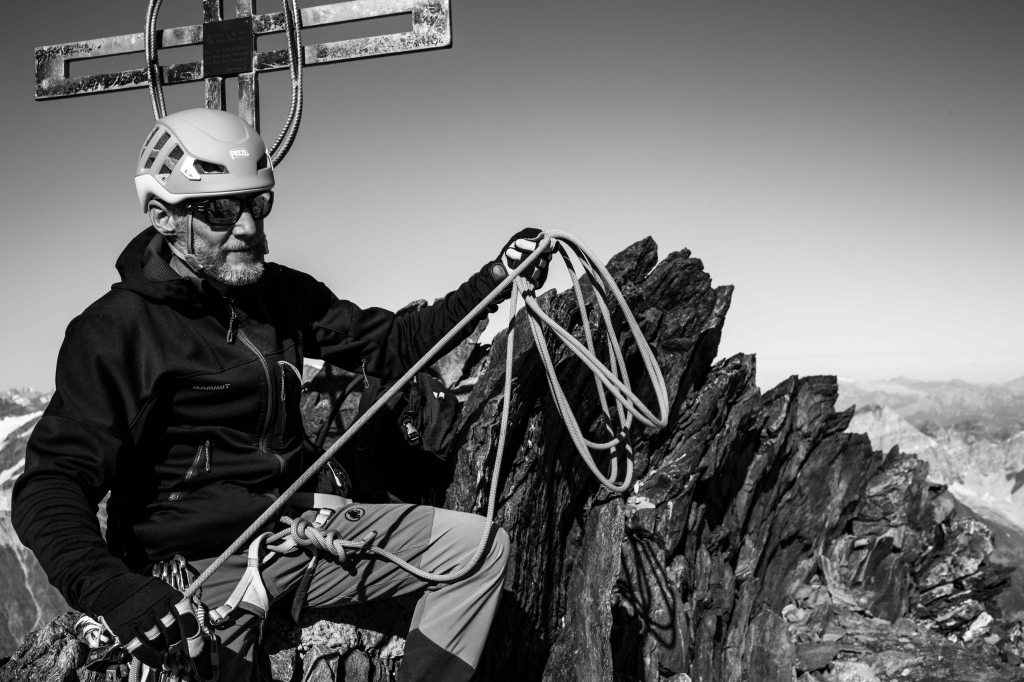
We finally made it safely to the icy moraine and stopped to take off our crampons and take a drink. Sebastian very diplomatically, politely and respectfully told me I needed to think more about his safety each time I stopped. I fully acknowledged and accepted his request and explained that it would also help me if he would let me know once he was clear of the crevasse. Hopefully next time, when we find ourselves in a similar crevasse maze, our communication will be better, we will be safer and there will be less frustration. A good climbing partnership is like a good marriage.
We made it to the car and as we drove home we looked up at the Lenspitze and were delighted to see ominous clouds forming around the summit – we had made a good call!
 Expeditions