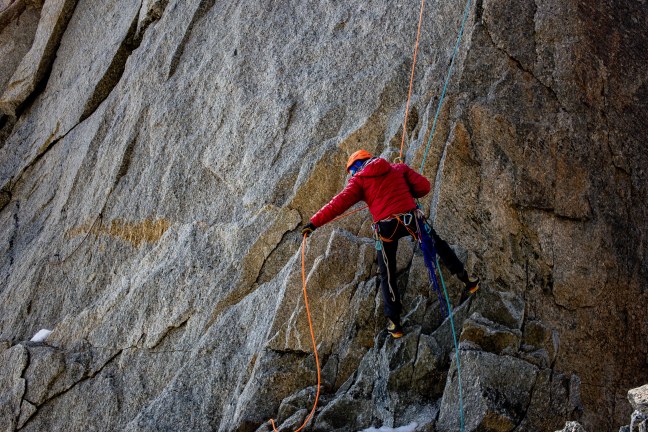
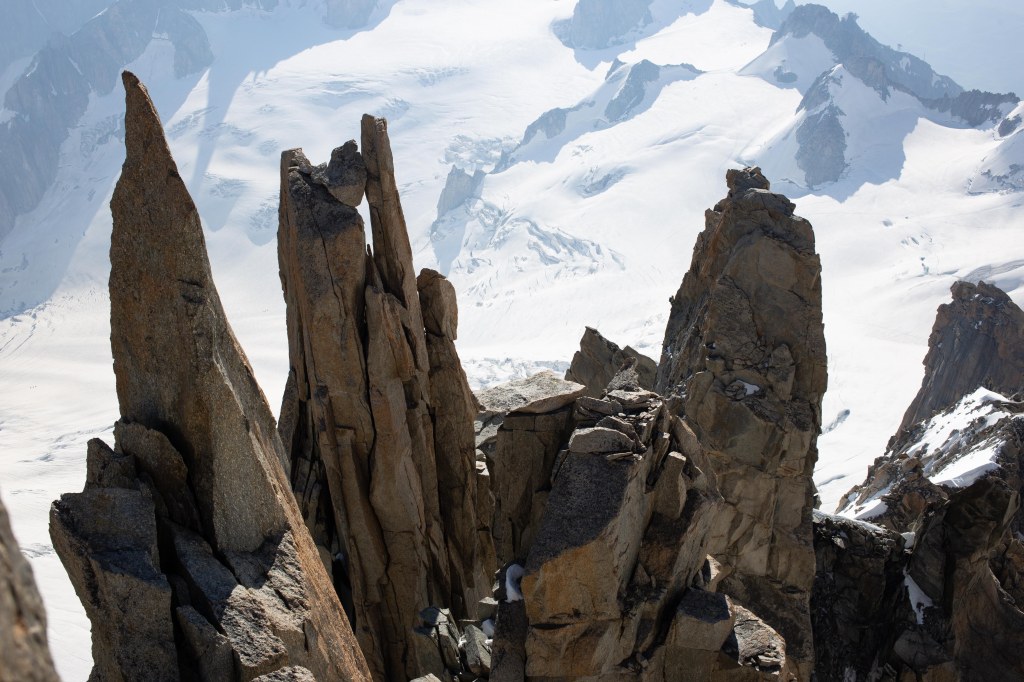
I had asked Bertrand to “step it up” and the traverse of the Aigulles du Diable is graded D+, a significantly higher level than anything I have attempted before and the hardest graded route in my guidebook. A traverse of challenging rock spires encompassing six 4,000m peaks high above the glacial snow and ice of Chamonix.
The reason I do these things, the reason I test, push and punish myself is for that feeling of excitement mixed with trepidation and terror that heralds the start of an epic adventure – it is the only time when I know I am truly alive. This feeling had been my constant companion in the build up to this trip.
At 2:00am I woke, ready.

For the first one and half hours we trudged through soft snow in the pitch dark – I really had no idea where we were, nor what surrounded us. I just simply followed the never-ending orange line which was Bertrand’s rope.
We eventually reached the rock and scrambled higher to join the ridge – nothing very challenging. As we approached the first spire, we came across an abandoned rucksack; we wondered what had befallen its owner.
Climbing difficulty is measured, using the French system, as a combination of numbers and letters. The easiest climbs being graded a one and increasing to nine and for each number there are subdivisions measured in letters from a to c, with the occasional + thrown in, if a finer definition is required. To put this in context, imagine a one as walking up the stairs and nine as attempting to scale a plate of glass – the highest grade ever climbed (according to google) is apparently is 9b+ (happy to be corrected on this!).
In rock climbing shoes (the really tight, pointy things), on an indoor climbing wall, I can currently climb to around 5c and when I was really into climbing, I was at 6a, possibly 6a+ on a good day. The Diable involves climbing at 5a and 5b but, in dirty great mountaineering boots making the task even more challenging – I would be at my technical climbing limit for most of the day.

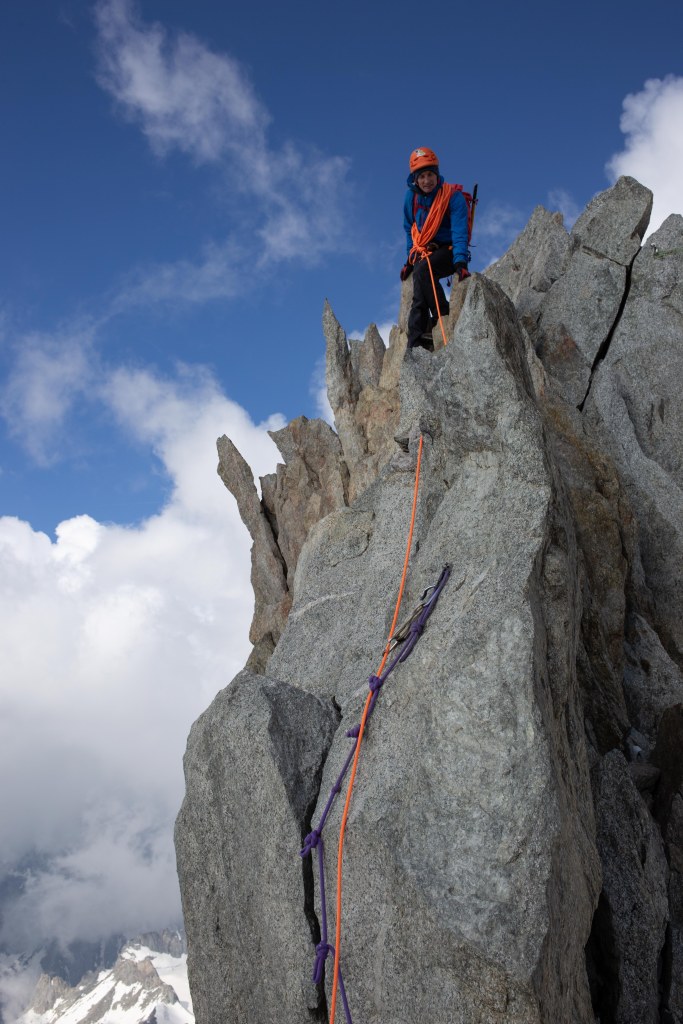
We began the first spike. I knew this was different because Bertrand was carrying a lot more protective gear than usual, things like “cams” (sometimes called “friends”) which can be jammed into rock cracks to provide an “anchor” from which he could belay / protect me. I also knew things were different because Bertrand normally just free solos the route ahead (as in no protection), before building an anchor and belaying me up to him. Today, I was belaying him from below on almost every pitch.
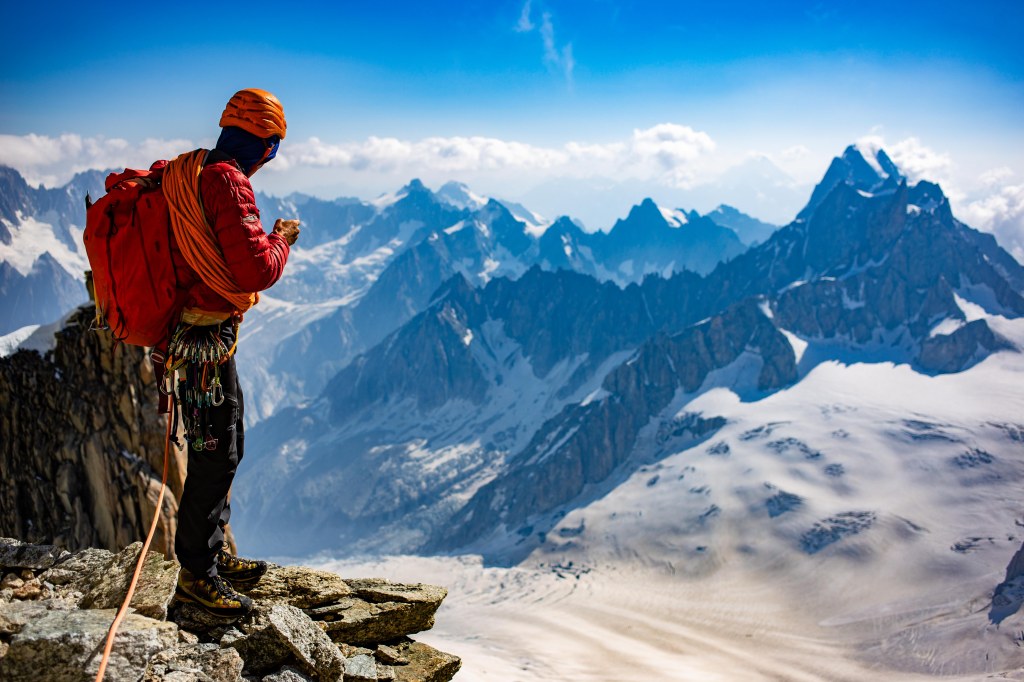
The spikes are vertical and there is nothing below your feet but air for 1,500m – the exposure is extreme. Despite being at my limit I was climbing with confidence and was making reasonable progress – later Bertrand would tell me I needed to make smaller moves as relying on my big, muscular manoeuvres would burn too much energy. I was halfway up the first spire when the rock I was holding broke away and I fell backwards into the void.
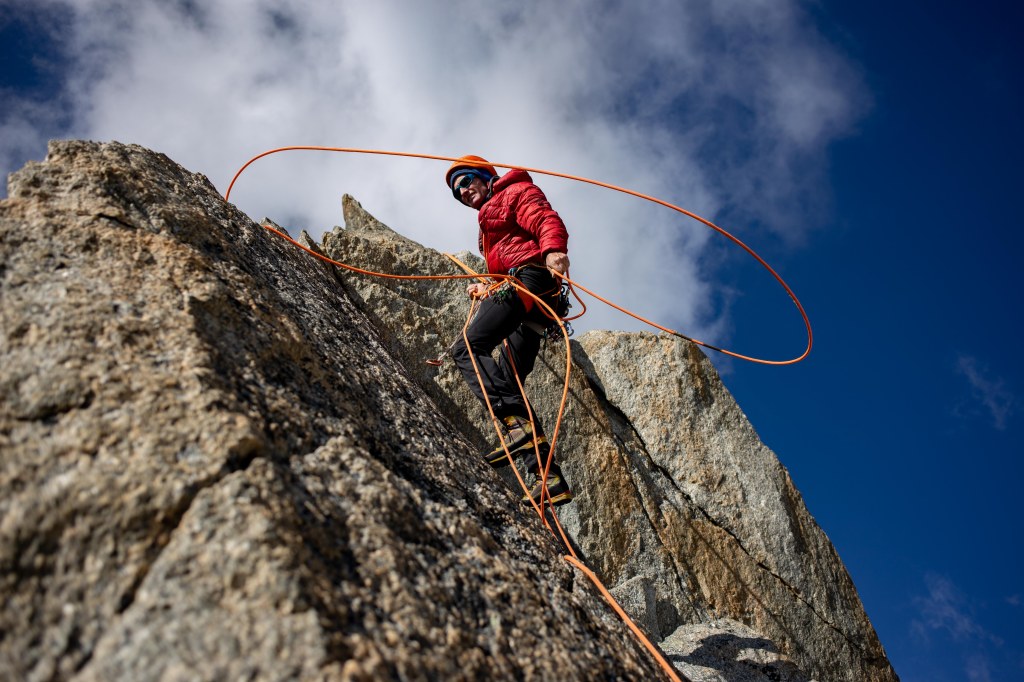
I wonder how many people can identify a moment when they faced death but their lives were saved by someone else? In that moment, Bertrand saved my life as the rope was attached to the bomb proof anchor he had built. Bertrand had the rope so tight that I did not even have a moment of panic inducing terror as I never even entered freefall. I simply swung back onto the rock and completed the climb.
I was less shaken by my near-death fall than I thought, but I would be lying if I did not say that my enthusiasm for climbing four thousand metre peaks that day was a little dented – yet there were five more to come.
We abseiled down the spire and began climbing the next. As Bertrand climbed, he would place gear to protect himself in the event of a fall. He placed mainly cams but also slings as well as clipping the rope into the occasional existing slings and odd bolt. My job as second was to follow the same route and clean out the gear as I progressed, placing each piece on my harness.

I arrived at a strategically placed cam (these things cost close to CHF 90 a throw) but I could not get it out. I stripped out the belay device and carabiner that was attached to it and clipped it to my harness. I then coaxed, bullied, threatened and cajoled the cam but it pointedly refused to budge. I leant back to consider alternative approaches when I heard the fearful sound of metal meeting rock. Somehow, and I have no idea how, I had managed to drop Bertrand’s belay device – the thing he would rely on to abseil off the peak of the summit.
I shouted up to Bertrand over the wind the bad news and he told me to continue climbing. When I arrived at the belay stations, this was the first time I have ever seen him anything other than completely professional – he told me “he would have it out in seconds” as I lowered him backdown to retrieve it. After a good while he climbed back up empty handed and he had the good grace to apologies for his slightly terse words. If he was cheesed off about his belay device, he did not show it and fashioned a belay device from two carabiners.
Climbing is a very emotional sport – there is only a certain amount of emotional energy you can deploy on a climb and after the experiences of the first two spires, my reserves were empty. I would have quite happily returned to the hut for coffee and almond cake. Yet, this is why I do these things. I seek out opportunities to empty the tank as it is only when those emotional reserves are depleted and yet you push on, do you extend your boundaries and the possibilities of your own existence. I told myself, “this is why you do this shit” and readied myself for the spikes to come.
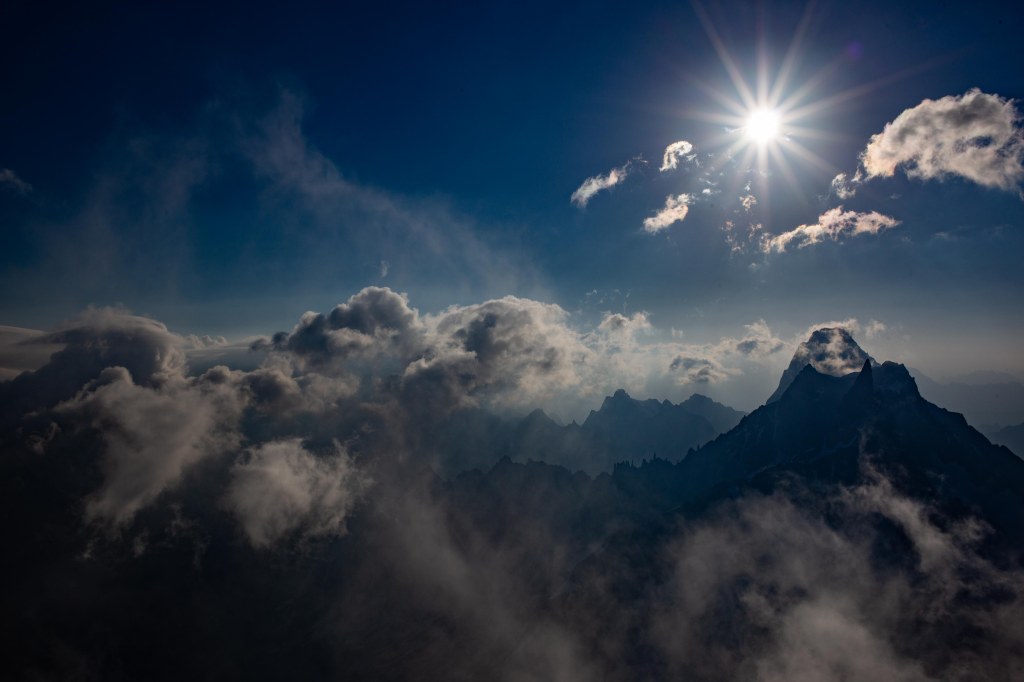
Having reached my limits and having decided to ignore them, I climbed the remaining spires with confidence and without issue. Five 4,000m peaks logged and only the Mont Blanc du Tacul still to climb. The final summit seemed to take for ever and probably because it comprised easy rock and a straightforward snowy ridge which seemed dull by comparison with the other peaks.
We began our descent and the heat of the sun had turned the snow rotten – every step we took resulted in a leg sinking to mid-thigh. The descent was steep and the down steps often large. I caught my crampon on the lip of a huge step and fell headfirst down the slope. Bertrand stopped my tumble turning into a death slide into the deep crevasses below with a sharp tug of the rope. The snow was so soft and deep I would not have gone far and I was more concerned about the snow now melting against my body below my shirt.
By this stage we had been on the move for 10 exhausting hours and a further three to four-hour trek through thigh deep snow and across ever weakening crevasse snow bridges was not appealing. Bertrand suggested we divert to the Aiguille de Midi and take the cable car back to the hut. Needless to say, I was in agreement.
The sun was beating down relentlessly as we crossed the glacier and began the climb back up to the Aiguille de Midi. Bertrand made the fatal mistake of telling me that it was normally 45 minutes from below the cosmic hut back to the top. I wondered how quickly we could do it and set off at a good but steady pace. We made it in 31.41 and predictably enough there was a Strava Segment – we are currently the all-time, 8th fastest, only a minute or so behind the KoM and we were not even working that hard and after 10 hours of hard slog.

I stopped the clock at 11 hours and 44 minutes and felt suitably proud to have nailed six 4,000m peaks and still be in time for coffee and almond cake at the hut.
 Expeditions